
Monthly Archives: June 2010

The Spirit of Jesus and the Works of Jesus

by Scott

I believe that one of the most essential things to grasp in regards to our understanding of the Holy Spirit is that the Holy Spirit is the Spirit of Jesus Christ.

What do I mean?

Well, for many, especially specific groups that might be identified as sects or cults, they only recognise the Holy Spirit as the Spirit of the Father. And, because of this, they de-personalise Him simply recognising that He is a kind of extension of God the Father, His power-force at work in the earth.

Such theology might remain in tact if we only had the Old Testament on which to build our theology. But one important pneumatological aspect the New Testament shows us is that the Spirit is the Spirit of Jesus. I believe this has bearings on two major theological areas: 1) the personal nature of the Holy Spirit and 2) the divine nature of Jesus.

The Spirit is no longer simply identified as the Spirit of the the Father, but also of Christ. And I believe this comes against the notion that He is simply a force (though there are points to consider with regards to the Spirit’s personality). And this also indicates what kind of nature Christ has, the divine nature just like the Father, since the Holy Spirit is His Spirit as well.

But where does Scripture identify the Holy Spirit as the Spirit of Jesus?

And when they had come up to Mysia, they attempted to go into Bithynia, but the Spirit of Jesus did not allow them. (Acts 16:7)

And because you are sons, God has sent the Spirit of his Son into our hearts, crying, “Abba! Father!” (Galatians 4:6)

For I know that through your prayers and the help of the Spirit of Jesus Christ this will turn out for my deliverance. (Philippians 1:19)

And it is important to also look at Jesus’ discourse on the Spirit in the whole of John 14-16. Though the Father would be sending the Spirit (i.e. John 14:26) we also see that Jesus taught that He would, likewise, be the sender of the Spirit from the Father:

But when the Helper comes, whom I will send to you from the Father, the Spirit of truth, who proceeds from the Father, he will bear witness about me. (John 15:26)

Nevertheless, I tell you the truth: it is to your advantage that I go away, for if I do not go away, the Helper will not come to you. But if I go, I will send him to you. (John 16:7)

There is a differentiation from the Father, though not a complete disconnect, and a distinct connection of the Spirit with the Son. This is crucial within the Trinitarian framework.

But why such an emphasis on Jesus’ sending of the Spirit and the Spirit being identified as the Spirit of Jesus? Because the Holy Spirit, the Spirit of Jesus, would continue the exact same work that Jesus initiated upon His arrival. This is why Jesus could say: I will not leave you as orphans; I will come to you (John 14:18). And Luke could start out his second volume, Acts, with these words: In the first book, O Theophilus, I have dealt with all that Jesus began to do and teach.

The Spirit Himself, who was both the Spirit of the Father and Son, would be sent to continue the work that Jesus was sent to originally do. But whereas the work of the Son was limited in His incarnation, the Spirit would now indwell and empower the entire company of God’s people to accomplish the same ministry and works of Jesus. Going back to John:

Truly, truly, I say to you, whoever believes in me will also do the works that I do; and greater works than these will he do, because I am going to the Father. (John 14:12)

Now, I am aware of what I might term as the ‘selective group’ argument and the ‘time limit’ argument. What do I mean by these two terms?

Well, the ‘selective group’ argument states that these words of John 14:12 were only expected of the original twelve. But I’m not sure that is a very defendable position and we could simply start by pointing out that the verse utilises these words: whoever believes in me. But, maybe for some, it’s not as simple as that. So let’s move on.

Here is where the fallacy lies for some with regards to John 14:12. When we think of the ‘works of Jesus’ from this passage, at least for many, they jump to think specifically of healings and miracles. Of course, this passage does teach that those who believe will do greater works. But I don’t believe this is a qualitative statement, but rather a quantitative statement, since you can’t get much greater than the Son of God Himself in all His varied works.

Thus, some make that ‘jump’ that identifies the ‘works of Jesus’, at least in the context of John, as healings and miracles. Now, the works of Jesus do include healings and miracles, but they also include proclamation of the gospel of the kingdom, mercy on the poor in spirit, compassion for the hurting, washing feet of our sisters and brothers, loving our enemies, words of knowledge, lovingly touching the outcasts, and so much more.

So, here is the point. There really is no ‘selective group’ in regards to the varied works of Jesus. We have got to stop identifying this statement as only referring to the ‘sign gifts’ or whatever we want to term them. This statement is much broader than that. It goes across the board with the works of Jesus.

But, if we want to reduce this statement to such specific acts of healings, miracles, signs, wonders, etc, then we have to recognise that quite a few others were used in just these such things beyond the twelve. Such examples are:

  • The 120 believers at Pentecost (Acts 2:4)
  • Stephen (Acts 6:8)
  • Philip (Acts 8:4-7)
  • Ananias (Acts 9:17-18)
  • Cornelius and his household (Acts 10:46)
  • Agabus (Acts 11:37-38; 21:10-11)
  • The Ephesian disciples (Acts 19:6)
  • The Corinthians believers (1 Corinthians 12:8-10; ch.14)
  • The Galatian beleivers (Galatians 3:5)

And by no means is that a complete list, nor if we listed every single biblical instance of these following Christ’s ascension does that mean that we have then identified every such act. Even Jesus did a lot more than was recorded in Scripture (John 20:30-31). I expect the same was true of His followers.

But one final note connecting back to the original passage quoted from John 14:12. Read the rest of John 14-16, since that is the fuller context. For those who want to argue that Jesus was only speaking to the twelve, notice how many times the language is much larger than the twelve, referring to the whole company of believers to come. Do we not see even these words below as relevant to us today?

13 Whatever you ask in my name, this I will do, that the Father may be glorified in the Son. 14 If you ask me anything in my name, I will do it. 15 “If you love me, you will keep my commandments. 16And I will ask the Father, and he will give you another Helper, to be with you forever, 17even the Spirit of truth, whom the world cannot receive, because it neither sees him nor knows him. You know him, for he dwells with you and will be in you. (John 14:13-17)

Now I am quite fine to identify that Jesus was initially speaking to the twelve. But did Jesus expect all of these words to stop there? Can we really invest in the belief that this was for twelve and the twelve alone?

Ah, but what about the ‘time limit’ argument. Many will easily recognise that others in the ‘New Testament times’ were being used in such gifts of the Spirit. But sometime at the turn of the second century, possibly following John, the apostle’s, death, some of these Spirit-gifts came to an end. They had exhausted their purpose, at least their purpose for being normative in the life of the church.

But again, this thinking is very reductionistic. Why would we expect some portion of Jesus’ ministry to continue, say two-thirds or three-fourths or even 95%, but not all of it? Oh, I know the many arguments from varying passages and theological perspectives. And I guess I cannot address every twist and turn of the cessationist perspective here in this short post. But do we really expect any part of Jesus’ ministry to have ended? Or do we really expect any part of Jesus’ ministry to have become ‘non-normative’? Mercy and teaching and gentleness are for the regular life of the body. Prophecy and healings and words of wisdom are not. Huh?

Remember, Luke started off his volume two by saying his volume one recorded all that Jesus began to do (Acts 1:1). So Acts kicks off with an expectation for things to continue and you have a church launching out into the works, all the works, of Jesus. They stepped out with mercy, compassion, serving, prayer, praise, teaching, evangelism, prophecy, healings, miracles, and even something Jesus probably never participated in, tongues and interpretation.

Remember, the Spirit who is activating these very works, again, all of these works, is the very Spirit of Jesus. You could expect nothing less, absolutely nothing less than the exact things Jesus walked in. Why? Because this is the Spirit of Jesus Christ. It’s really as simple as that.

Jesus comes doing the things of the Father (John 5:19). He even announces that if you’ve seen Him, you’ve seen the Father (John 14:9). And so the Spirit comes initiating in Christ’s people the exact same things that Jesus started out with. And so the church, empowered by the Spirit, should be able to state, ‘We only do the things that Jesus did. If you have seen us, you have seen Jesus.’ If only that were our testimony more regularly.

And this is across the board. Not just with the fruits of the Spirit, but also with gifts of the Spirit. Not just with ‘signs and wonders’, but also with serving and washing feet.

The Father and Son sent the Spirit for a purpose. To help empower the entire body of Christ to accomplish the entire work of Christ across the entire planet. At times, it will involve laying our hands on the sick and seeing them restored. I remember a friend of mine who laid his hands on another young man’s hands that were filled with warts. He asked in Jesus’ name for the hands to be cleared, and when he removed his hands following the prayer, there was not a trace of warts. It softened that young man’s heart. But at times, it will involve serving a bowl of hot soup to a hurting and homeless refugee with a word of kindness. Both communicate the heart of Jesus. Both are wrapped up in the works of Jesus.

So let us look to see the Spirit of Jesus Christ Himself empower us to serve with the works of Jesus, however that may look today and tomorrow. We have a mission to accomplish and we will not complete it effectively apart from the Spirit’s work. We will not walk in the works of Jesus, in all their varied aspects, without the Spirit of Jesus Himself.
What Is a Prophet – Video

Below is a video in which a close ministry partner of mine, Ian Rawley, gives in depth insight into what the prophetic ministry is all about. The video was produced 10 years ago, but the material remains solid teaching about this important ministry gift given to the church by Jesus Himself.

Response to Patton’s “Why I’m Not Charismatic” (Part 4)

by Scott

Marv and I are currently working through a series in which we are interacting with Michael Patton’s eight-part series entitled “Why I’m Not Charismatic”. You can also download Patton’s series in a 22-page PDF file.

Thus far, we have posted three articles responding to his first three parts.

By the way, you will probably notice right up front that Marv’s posts carry much wittier titles and arguments than mine. I guess I am the dry, dorky, pastoral-theologian. Oh well. Thankfully we are a tag-team here. So now I somewhat dryly continue on with part 4.

If you read part 4 of Michael Patton’s series, I suppose you will respond in either one or a combination of ways: 1) anger, 2) frustration, 3) brokenness, 4) embarrassment and a whole host of other possible emotions.

Patton’s part 4 is a kind of side excursus where he shares of one particular person’s negative experiences with prophecy. Even as a continuationist, I am quite aware of such stories and examples right throughout Pentecostal, charismatic and third-wave circles. Matter of fact, as the proverbial statement goes – We’ve all been there, done that. Even if we haven’t personally been a part of negative experiences, we’ve at least seen such on television or heard enough stories from our friends and colleagues.

And such truly breaks my heart. But, even more, it breaks the heart of our Father.

But let me start off by giving what is probably one of the wisest nuggets I can give when it comes to the Holy Spirit and spiritual gifts: Abuse and misuse should not lead to no use, rather it should lead to biblical and healthy use. Or, to say it another way: Abuse and misuse should not lead to disbelief in something, rather it should drive us to truly understand how to faithfully walk it out in accordance with the Scripture.

Those who know me and read my stuff regularly will note that I say that statement quite a lot. And I expect a rolling of the eyes from some due to the perpetual nature of the statement from my lips (or keyboard). But I believe that is truly the biblical approach to most problems we face with the practise of our faith. And I definitely disagree with the approach of abandoning something all together because of abuse and misuse.

Again, I know that abuse takes place. I know things go wrong. At times I want to hurl at what I see on what is labelled as ‘Christian television’. But I cannot allow such to push me to abandon what 1) I believe Scripture teaches and 2) what I have seen God do in mine and the lives of others.

Here is reality: There is abuse right across all aspects of the Christian life. We can name just a few. What about leaders who sexually abuse children? Should we never trust leaders? I don’t believe that is the answer. Divorce rates are just as high in the church as in the world. Should we just abandon marriage? I don’t believe that is the answer. I know plenty of people claiming the name Christian but don’t live at all like the one we are named after, Christ. Should I abandon the faith all together? I don’t believe that is the answer.

Again, I believe the answer is this: Abuse and misuse should not lead to no use, rather it should lead to biblical and healthy use.

Well, that is not a band-aid answer to fix all things. What might possibly be needed is deep emotional healing from abuse. What might also be needed is to find another church community to be a part of. But I believe a mature body of Christ will not ultimately allow abuse and misuse to determine where they stand. They will rather desire to pursue God, study the Scriptures and look to see what it teaches outworked in their lives, which includes the workings of the Holy Spirit Himself.

Now, the person that Patton quotes in his article also observes that none of the prophecies that he has heard spoken have ever come true. None.

I don’t know this person in particular and I don’t know the people who he says have ‘prophesied’. So I really cannot address him or them particularly. But what I can say is that I have heard plenty of prophecies in my life in Christ that have come to fulfil their purpose. I don’t use the normal phrase of ‘prophecies that have come true’ because, while I am ok with that wording, I do believe it can create a wrong perception about prophecy.

What does Paul say the fruit of prophecy will be?

On the other hand, the one who prophesies speaks to people for their upbuilding and encouragement and consolation. (1 Corinthians 14:3)

And to see this accomplished, one does not have to predict something. You see, we have fallen into the trap of believing prophecy is only about predicting things to come. Not only the hearer, but also the one speaking can easily fall into this false notion.

Now listen, I do believe prophecy can have a predictive element. But that is secondary to its primary purpose of being a specific message from God (an unveiling of God’s heart and purpose) that brings about edification, exhortation and comfort to the body of Christ. And when we allow prophecy to function in the bigger framework that God Himself desires, we will realise that 1) we don’t always have to announce that something is going to happen and 2) we aren’t looking for it to ‘take place’ within our own prescribed time frame.

Again, I believe prophecy can have a ‘predictive’ element to it. I’ve seen this in my own life. Right now I’m specifically thinking about a prophecy given to me by a ministry partner a few years back as a group of leaders were gathered together. It came to fulfilment (and is still being fulfilled), but only after about a 3-year period.

And that’s just it. When prophecies are given that speak of something that will take place at some point in the future, we in this microwave generation of everything-must-happen-in-3-minutes sit around expecting it to happen automatically. Or, we might give it a week or two at most. But don’t we realise that even some prophecies found in Scripture took a long time to be fulfilled? There was the 25-year waiting period for Isaac to be born. There were the centuries of waiting for the Messiah to actually arrive. And we are still waiting for Christ to return to make all things new.

Not only that, but we must also realise that there is an unfolding nature to some prophecies. As I said, a ministry friend of mine prophesied something that took about 3 years to come to fruition. But I believe that prophecy is still being fulfilled, still unfolding with its blessing and fruit from God. Plenty of prophecies from Scripture fall in that category as we are still living in the Messianic age of the new covenant. God is still pouring out His Spirit on all flesh (Joel 2), still writing His laws on people’s hearts rather than tablets of stone (Jeremiah 31).

The problem is that we build such wrong assumptions of what prophecy is. And this is not only true for the cessationist but also just as true for the continuationist. You know the silly ones:

  1. You must begin a prophecy by stating, ‘Thus saith the Lord…’
  2. You must use Thee and Thou.
  3. You must shout.
  4. You must include a few Hallelujahs.
  5. You must only prophesy on Sundays and not the other days of the week.

Those are a bit silly, but we do build up wrong presuppositions of what prophecy is. Here are more likely ones:

  1. Prophecy is always predictive. [I addressed this above.]
  2. Prophets did not exist after the apostles came. [Plenty of prophets existed in the New Testament: Agabus, Judas and Silas, prophets in Antioch, Philip’s four daughters, prophets in Corinth, etc.]
  3. Prophets are specifically those who wrote the Old Testament Scriptures. [There were plenty of prophets that did not pen one word in Scripture – Elijah, Elisha, Nathan, Agabus, etc.]
  4. Prophecy must be accompanied with signs. [Is that true of all prophets like Nathan, Gad, Micaiah, Agabus, Judas and Silas, etc?]
  5. Prophecy must be fulfilled within our prescribed time frame. [I dealt with this above.]

And there are a host of other false assumptions of what prophecy is and what the ministry of a prophet is. It takes time to take off the wrong lenses and see them replaced with the correct lenses. But it is possible. It happened with me and it happened with my colleague here, Marv. We both were cessationists and we both had our theology radically changed via God’s Word and true interaction with the Spirit’s gifts.

A couple of more things.

Patton included these words from the disillusioned person who had converted from continuationism to cessationism:

If you have the gift of prophecy and it is working for you and you have evidence to back it up, please contact me. I would love to be proven wrong. I am serious as a heart attack. I’d rather prophecy be happening rather than not.

I’m not trying to give a cop-out excuse and side-step things, but this is really not how it works. I promise you this isn’t the design of the Spirit of God Himself. Maybe I should have listed it above in the false presuppositions we have about prophecy. Prophecy isn’t like an on-off light switch that you kind of control when you want. I’m sorry to say this, but it just does not work like that.

Now, for the one who is used regularly in this gift, I would not deny that they could ‘on the spur of the moment’ be used in prophecy. But it doesn’t work with an, ‘Oh yeah, prove it.’ You remember what happened to the Son of God right before His crucifixion. People were beating Him, taunting Him and saying, ‘Prophesy to us, you Christ! Who is it that struck you?’ (Matthew 26:68). He could have. It would have caught there attention. But such did not fit into the purpose of prophecy or the plan of the Father.

What I can do is give you testimonies in my life, which I have alluded to above. And I can point you to some posts even on this blog that gives examples of faithful prophecies and hearing God’s voice (see this post, this post and this post). But I am pretty convinced, at least from Scripture (i.e. 1 Corinthians 12:11), that this is something God is in charge of. Not to mention that it seems pretty obvious that these gifts were not accessible in an ‘on-off’ fashion from reading the narrative portions of Scripture where these men and women of God were used in such gifts.

Oh, we are called to pursue Him and His gifts. But this is not a water faucet that we turn on and off whenever we want. Even Jesus looked to the Father to know when to do something and what to speak:

Truly, truly, I say to you, the Son can do nothing of his own accord, but only what he sees the Father doing. For whatever the Father does, that the Son does likewise. (John 5:19)

Do you not believe that I am in the Father and the Father is in me? The words that I say to you I do not speak on my own authority, but the Father who dwells in me does his works. (John 14:10)

Remember, I post this article very aware of the grave failures of prophecy and other spiritual gifts. I can probably even easily point to my own failings with prophecy: 1) speaking that which I should not have and 2) not speaking what God I should have. And maybe we are all sometimes guilty of number 2 because of number 1. So I know the pain and hurt. I have seen it and heard plenty of stories to shake my head at.

But, though experience does truly shape our theology, and such is not evil in and of itself, I always encourage the flock that I shepherd, a flock of multi-cultural and multi-church backgrounds, that abuse and misuse should not steer us away from what Scripture teaches and God desires. Rather we will look to be a people that know God’s heart by centering our understanding in His Word and we will look to practise such gifts with as much faithfulness as possible as we stay humbly submitted to Him. That, I am convinced, is the heart of God.

The Use of Luke-Acts For Developing Our Pneumatology

by Scott

When it comes to developing our pneumatology, or our theology of the Holy Spirit, there has been much discussion on whether or not we can utilise the Gospel of Luke and the book of Acts to inform our understanding. Honestly, some have not been keen on the idea of utilising Luke-Acts, since they would see it as more descriptive rather than didactic (teaching doctrine). Such a group would see the epistles (i.e. Paul’s letters) as the primary didactic source for our pneumatology and the descriptive parts (such as Luke-Acts) as secondary in teaching doctrine.

So, is it worth utilising Luke’s words in both his Gospel and Acts as a primary source for developing our theology of the Holy Spirit? Or should Luke’s two-volume work be seen more as a secondary pneumatological resource?

There are a couple of points I believe that are worth noting:

Luke as Both Historian and Theologian

An important thing to notice is that Luke stands as the only recorder of the early church and its history. Other Gospels (3 of them) had been written alongside Luke’s. But he alone holds a unique position as presenting early church history. It leaves us asking if his words should be relegated as secondary to the epistles or if they will give us a better understanding of the Spirit of God and His work.

If we are honest with the text, and note Luke’s pneumatological purpose in his recording of early church history, Acts does stand as a vitally important theological work. And its significance is especially heightened when studied with its preceding volume, the Gospel of Luke, as Luke emphatically highlights the work of the Spirit in the life of Christ.

So, whereas in the past, many evangelical theologians would have not seen the benefit of developing doctrine from narrative portions of Scripture, there has been a much great acceptance of such in recent years. This is a very important recognition, for we can definitely learn from narrative parts. We can learn just as much from God’s deeds as we can learn from God’s words. Even more, this inspired account of early church history is where theology and doctrine are being walked out in daily life. Thus, it carries importance. This is why I believe that Luke must be respected as both historian and theologian.

Below are a few passages showing how we can receive instruction from the historical recordings of Scripture.

For whatever was written in former days was written for our instruction, that through endurance and through the encouragement of the Scriptures we might have hope. (Romans 15:4)

Now these things happened to them as an example, but they were written down for our instruction, on whom the end of the ages has come. (1 Corinthians 10:11)

Yes, it is definitely true that Luke presents a descriptive history of the church in his second volume, Acts. No one can argue with such. But, what we must be willing to recognise is that it is a didactic history at the same time. There is no doubt that Luke wrote to teach. He did not only write to describe, he wrote with a purpose to instruct us, just as the writers of old would have done with their narrative portions of the Old Testament text.

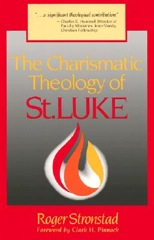
As theologian Roger Stronstad reminds us:

‘If for Paul the historical narratives of the Old Testament had didactic lessons for New Testament Christians, then it would be most surprising if Luke, who modelled his historiography after the Old Testament historiography, did not invest his own history of the origin and spread of Christianity with a didactic significance.’ (The Charismatic Theology of St. Luke, p7)

Not only that, but we have these oft-quoted words of Paul:

16 All Scripture is breathed out by God and profitable for teaching, for reproof, for correction, and for training in righteousness, 17 that the man of God may be competent, equipped for every good work. (2 Timothy 3:16-17)

Paul envisioned all parts of Scripture as God-breathed and useful for teaching. To say that certain portions of Scripture take precedence over others is not easily established from Scripture itself.

Luke Speaks For Himself

What I mean with this subheading is that, many times, theologians will try and squeeze Paul’s specific theological emphases into Luke’s theology. Thus, we end up reading Luke through a Pauline lens, which is not at all helpful.

Of course Scripture presents a harmonious whole. There is a unifying structure and nature to the entire text. But we need to give room for Luke to speak as Luke, rather than try and make Paul’s words fit into Luke’s words (or vice versa). For Luke is himself trying to teach us something about the Messiah, the mission of the church, the work of the Spirit, and a whole lot more. Let’s give this man room to teach us, even teach us apart from Paul’s own words.

Even more interesting, when it comes to the baptism and filling of the Holy Spirit, Luke speaks about these two issues many more times than Paul ever does. Consider these statistics:

  • Baptised in the Spirit: Luke 3 times; Paul 1 time
  • Filled with the Spirit: Luke 9 times; Paul 1 time

Not only that, but Luke utilises a lot of different phrases to describe these similar actions: the Holy Spirit came upon; the Spirit was poured out; the gift of the Holy Spirit; the Spirit fell on people; people received the Spirit. If we take all of these into account with regards to being baptised and/or filled with the Spirit, Luke has a lot to contribute on this topic. Our ears should be tuned to this man’s words.

Stronstad shares some more insights:

‘Consequently, just as the recognition that Luke is a theologian as well as a historian makes Luke-Acts a legitimate data base for the doctrine of the Holy Spirit, so the recognition that Luke is independent of Paul will broaden the New Testament data base for the doctrine of the Holy Spirit. To recognize these two facts is to rehabilitate Luke as a historian-theologian of the Holy Spirit and to allow him to make a significant, unique, and independent contribution to the doctrine of the Holy Spirit.’ (p11)

Thus, I agree wholeheartedly with this final statement of Stronstad:

‘On the one hand, where it is appropriate, all parties in the current debate must abandon those largely self-serving methodological programs which conspire to either silence or to manipulate Luke’s distinctive theology. On the other hand, all parties must develop a methodological consensus for interpreting the gift of the Spirit in Luke-Acts. At a minimum, this consensus must include the following principles: 1) Luke-Acts is theologically homogeneous, 2) Luke is a theologian as well as a historian, and 3) Luke is an independent theologian in his own right.’ (p12)

And just as a side note, another great work on how Luke should be viewed as not only historian, but also theologian, is I. Howard Marshall’s Luke: Historian & Theologian.

As we look to develop a holistic pneumatology, consistent with the full text of Scripture, we must not forget Luke’s words and set them aside as only secondary to the words of Paul. Of course, we must also not pit Luke and Paul against one another, noting they were part of the same ministry team at times and are both within the canon of Scripture. But Luke’s words will, no doubt, enrich our understanding of the work of the Holy Spirit. All we must do is allow for them to teach us.

“Charismatics are wrong ‘cuz it never happened to me” …and Other Stupid Statements. (Response to CMP, part 3)

By Marv

This post is part of a series responding to C. Michael Patton’s eight-part series at Parchment and PenWhy I am Not Charismatic,” which is also conveniently available for download as a single e-book here. This is in response to part three.

Michael,

First, please don’t take the title too seriously.  It is, as you might suspect, an hommage to your own provocatively titled series, last seen here.  Besides, you start your part three by admitting that its argument is (a) not a very good one and yet (b) one that works for you.

I appreciate the irony though.  In certain circles it is Self-Evident Truth that Continuationists (a) follow experience over Scripture, and (b) are doing that “evil and adulterous generation” sign-seeking thing (Matt. 12:39; 16:4).  Yet here you tell us, first, that while the preponderance of Scriptural evidence backs Continuationism, you remain a Cessationist due to your experience.  Then, second, you demand a sign, failing which, you remain a (de facto) Cessationist.  It’s refreshing, to say the least.

With that introduction, here are a few thoughts on your part three.

1.  You are “open” Biblically and theologically to Continuationism.

The other day I heard somebody on the radio giving the usual condescending admonition to Continuationists always to give Scripture priority over experience.  This same guy kept making reference to “the four sign gifts.”  It was the first time I’d heard these given a definite number.  (Does that mean tongues has ceased but interpretation of tongues continues?)  I’d really like for him to put his money where his mouth is and show me the Bible passage teaching “the four sign gifts.”

Be that as it may, of course Scripture is the only infallible rule of faith and practice.  Michael, you pointed out some strong Biblical support for Continuationism in your part two.  As Scott has observed, you did seem to leave out Christ’s own teaching on the eve of his crucifixion (John 14-16).  This, I submit, is the place to start, and really leaves no doubt that the Father’s plan, the Lord’s instruction, and the believer’s expectation should be:

Truly, truly, I say to you, whoever believes in me will also do the works that I do; and greater works than these will he do, because I am going to the Father. (John 14:12)

So, Michael, if the Bible teaches something, if Christ teaches something, what kind of response is it to be “open” to it?  Try saying, “I’m open to that salvation-by-grace-through-faith thing, but I’ve never had a genuine gospel experience.”  The apostle Paul tells us to: “Pursue love, and earnestly desire the spiritual gifts, especially that you may prophesy.” (1 Cor. 14:1) I mean, you don’t suppose “be open to” is an adequate translation of zeloute here?

What I am trying to say, Michael, is that as far as you’ve come from your previous self-confessed bias against Continuationism, if the Bible supports it, then why not move beyond “openness”?  Your lack of experience, I suggest, is in part due to lack of conviction that the Bible really teaches this.  What you see depends on what you expect to see.

POLICE INSPECTOR: “By George! How ever did you see that?”
HOLMES:  “Because I looked for it.”

2. Your expectations.

So what are you looking for, Michael?  May I suggest, based on some of your remarks, that you may have spent some time barking up the wrong proverbial tree?

First, as odd as it seems there is a whole preconceived notion about just what a “gift” is that may need rethinking.  You remark:  “I have never witnessed anything that would lead me to believe that someone has, as their gift to the body of Christ, any of the particular gifts…”  Well, if by this you mean some kind of at-will wonder-worker, I don’t think this has ever been the case. 

The concept of “gifts” is a reference to the fact that the works of Jesus, done by the Body of Christ, are distributed among the members.  These are first of all gifts given by the Lord to us, not our gifts to the Body.  Second, I don’t think the Bible teaches us it was like a team of spiritual X-men:  X has the power of prophecy, Y has the power of healing, Z has the power of tongues.  Based on what Paul says, on a given day any believer may give a prophecy, though not all will (1 Cor. 14:26, 31).  It may have been that some people particularly excelled in a particular gift, and so may be associated with it, but I think it is fallacious to understand a rigid one-for-one correspondence.

Second, in regard to prophecy, you refer to “the surrendering of my mind.”  I don’t think that is what New Testament prophecy calls for.  Paul says prophecy gives “upbuilding and encouragement and consolation” (1 Cor. 14:3).  It may instantly resonate with someone (1 Cor. 14:24-25) or else is to be weighed (v. 29). 

As far as requiring a “sign” is concerned, well first, I thought you considered prophecy a “sign gift.”  Isn’t it already a sign, then?  “prophecy is [a sign] not for unbelievers but for believers,” Paul says (1 Cor. 14:22). 

Besides, with all the New Testament teaching on prophecy, and the clear “democratization” of prophecy in Acts 2, you go to Moses for the example of how things are to be done?  Deut. 34:10 states: “And there has not arisen a prophet since in Israel like Moses, whom the Lord knew face to face.”  It might be nice if all who prophesied lived up to Moses example, but I wouldn’t expect this.  Is this really reasonable?

Also (and I just love it when Cessationists tell Continuationists how spiritual gifts ought to work) you opine:

If someone claims to speak on behalf of God—if someone claims to have a prophetic gift—you have every right and obligation to demand an attesting sign. As well, if you think you are a prophet—if you sincerely believe that God has called you to such a ministry—you need to tell God that you cannot do so without such a sign.

Okaaay, kids, always remember to talk back to God.  Umm, Michael,  in the first place, you draw on the example of Moses, whose demand for authenticating sign was not so much a sign of faith, as of reluctance, hesitation, doubt.  God had already given him His word to proclaim, and Moses hemmed and hawed until he ran out of excuses.  Go and do thou likewise?  So say you, Michael?

Second, this whole thing isn’t about anyone’s claim to have this or that gift.  It’s about believers being the Body of Christ, and God giving His words and doing His works through us, as he did through Jesus (John 14:10).   

Furthermore, it isn’t only prophets who speak on behalf of God.  Teachers, such as yourself do. 

As each has received a gift, use it to serve one another, as good stewards of God’s varied grace: whoever speaks, as one who speaks oracles of God.  (1 Pet. 4:10-11)


Therefore, we are ambassadors for Christ, God making his appeal through us. We implore you on behalf of Christ, be reconciled to God. (2 Cor. 5:20)


Are pastors, teachers, and evangelists also to demand from God a sign, since they too speak on behalf of God?  Well, the good news is, we don’t need to demand, because God has always planned to co-testify as we deliver His message (Heb. 2:4).

In regard to what you say about healing, again, I think you are under a misconception to imagine a “gift of healing” as attached permanently to a particular person.  This is not necessarily what we as Continuationists are saying.  Moreover, your conceptually separating  praying for healing from “gifts of healings” is also missing the point.

But you knew I would say this, didn’t you.  And you head this response off at the pass.  You are told “that’s not the way it works.”  And, of course, you, a Cessationist–never seen it–know better:

If you say, “It’s not like that. God simply uses me sometimes to heal. I never know when he is going to and when he will deny such a request.” I would say that we are simply talking past each other. In my estimation, you do not have the gift of healing. You, like everyone else, simply have the ability to pray for healing, leaving the answer in the hands of God.


I agree about the talking past each other here, but, Michael, let me say gently, it might behoove you back up, hold your preconceived notions loosely, and listen to that perspective–there just might be something to learn.

When you begin to learn, you first do not even know what you do not know.  Some things need to be unlearned before learning can take place.

3.  The learning curve.

I don’t say that, or write these posts, claiming vast amounts of knowledge.  Only, it is really is a strange thing when Cessationists are sure they know more about spiritual gifts than Continuationists.  You point out how others aren’t doing it right.  Their prophecy is banal.  Their prayer for healing and any subsequent answers to prayer is not “the gift.”  Well, I agree that the Continuationist side may not be doing everything quite right.  Yet they are believing the Lord’s instructions, and doing something, and mixed results are better than no results. 

The church today largely has to rediscover what has been forgotten.  As with any practice, there is a learning curve.  At one time, these were passed on.  Jesus instructed His disciples how to minister in power, and they taught others.  Well, we haven’t got that now, I grant you. And I am not for an instant suggesting that contemporary Continuationists are infallible guides.  Still, how wise is it to completely disregard these?

So where are we to begin today? To recover what the Scripture teaches but generations have not really practiced?  You begin with the Scriptures, of course.  You begin by being convinced from Scripture that the works that Jesus did ought to be in evidence in the church today. 

But what does this look like?  Prophecy, for example.  How do you do it?  How do you know when it is happening?  Does it feel like something?  Does the prophesier hear a voice?  Audibly?  Inaudibly?  How do you really know it’s God?

I submit, Michael, you won’t know the answers by sitting on the sidelines.  There is hit and miss here, trial and error.  Does that seem little too messy?  Well, what are we supposed to do?  Don’t like the whole glass-half-empty thing?  The Cessationist answer seems to be “I don’t see any New-Testament quality miracles,” so out it all goes. 

What about half full?  How about getting in there and helping?  Don’t quite like the way things look in the Pentecostal, Charismatic, Third-wave, whole Continuationist world? So many of the Bible-scholar, teacher types have retreated into Cessationism, and left others to fend without them.  Is there a lack of balance in Continationism?  Whose fault is that?  Those who are in the game or those who are not?  For my money, I’d point a finger or two at the armchair quarterbacks.

4.  Get in the game.

So what we’re talking about here is you’ve never had a “genuine charismatic experience.”  Well, okay, you used to go to a “third-wave” college.  These days, do you ever put yourself in an environment where you might just have such an experience?

I was going to point out, if you were not already aware, that you have a fabulous opportunity in Sam Storms having moved to Oklahoma City.  Then of course I saw here that he’s now on Theology Unplugged.  Okay, so you two have met.

Still, my point is Credo House is what, 3-1/2 miles from Bridgeway Church?  Dr. Storms is, as you know, top notch in Bible exposition and theology.  And I doubt you can find a better go-to-guy for Continuationism–in these United States, anyway.  I believe Dr. Storms was not in town when you wrote this series last year.  So okay.  Now, however, you have no excuse.