
Category Archives: 1 Corinthians 14

Pyro Techniques?

By Marv

There was a little girl, who had a little curl, applied directly to the forehead. When she was good, she was very, very good. When she was bad, she was horrid!

Speaking of Team Pyro

As a frequent reader there (Pyromaniacs), frequent writer here (To Be Continued…), I’ve known sooner or later it would happen. I find myself pretty much in their camp on most things–with one major exception–which happens also to be the subject of this blog–Continuationism. I knew eventually I’d have to post something to be applied directly to the horrid.

I figured I’d wait until one of the crew posted some cogent argumentation for Cessationism, and then counter with a well-reasoned, insightful, exegetically-based, Biblical response. But then Dan Phillips today offers a 26-worder in which he basically says: “Don’t bother.”

His pithy posting we can reproduce in toto (plus title):

Tersely put: “continuationism” self-refuting

The very fact that “continuationists” acknowledge the need to make their case to Christians by argument is, itself, a devastating and sufficient refutation of the position.

Now what are we to make of this epigram, which would seem to be a low and inside pitch, or to change metaphors, a little bit of choir practice? Mr. Phillips, sir, you force me to bring out the numbers.

1. As best as I can decipher his meaning, being a bear of little brain, I would paraphrase thus: Continuationism is about the showy-stuff. If you can’t show me the showy stuff, what good is to give me a bunch of telly stuff? Cessationists of this ilk are prone to refer to certain gifts as “spectacular” or  “dramatic,” with razzle dazzle like a kind of magic show:

Give ’em an act with lots of flash in it, and the reaction will be passionate.

While a manifestation of the Holy Spirit may well be impressive, especially to those to whom His work is directed (e.g. 1 Cor 14:24-25), we would be wrong to expect Him to put on a show for us. His effects are deeper, directed toward spirit, heart and mind: “upbuilding and encouragement and consolation” (1 Cor. 14:3); conviction of “sin and righteousness and judgment” (John 16:8).

2. Behind this statement lies a number of Cessationist misconceptions about how “spiritual gifts” work. This type of argumentation (much in the MacAruthur tradition) I call the Unicorn and Jackass show. Insist on a unicorn: a mythological beast, which never existed: such as a “gift of healing,” with which an individual is endued (something like an X-man super power), operating at will, always efficacious, instantaneous, permanent, irreversible. Or inerrant oral prophecy, which neither the Old nor New Testaments teach (the Scriptures yes, oral prophecy, no.) Then with this expectation bring out the jackasses. This can be done in as few as two words: Benny Hinn.

3. Note the formulation of his statement. Quotes around continuationists. Why? The use of “need” (always a red flag for misleading argumentation). I’d like to know who he is purporting to quote here as “acknowledging” this or that. Who knows? Maybe it’s Team Continuo here. I doubt it, but we do acknowledge the importance of Biblical argumentation.

4. Which makes it odd, coming from a blog that otherwise highly values “argumentation,” appeal to Scripture and right reason, that one of them would denigrate such in this case.

5. So often Cessationists accuse their Continuationist bretheren of basing their view on experience rather than the Scriptures–all the while doing this very thing themselves, as in this case.

6. So often Cessationists accuse their Continuationist bretheren of being “an evil and adulterous generation [who] seeks for a sign,” and then themselves insist on a “spectacular” sign, or else they will not believe the Scriptures.

7. It is the Scriptures themselves that teach Continuationism. We see both in the direct teaching of our Lord (John 14: 12) and of His apostles (1 Cor. 12-14), that it is the Father’s will, and to His glory that the Body of Christ continue Christ’s empowered ministry between Pentecost and Parousia. One looks in vain for valid support of the notion that any of this would cease within the first century.

8. We are called to pursue these gifts (1 Cor. 14:1), but to do so we must be convinced that the Scriptures do in fact teach that they are for today as well as for the first century. This cannot be done by experience, but only by examining the Scriptures. Whatever we do, we must do in faith, and faith must be grounded in the Word. Thus argumentation.

9. So anyway, if we show you something “spectacular,” you say, there are “lying wonders.” Just because it’s supernatural doesn’t mean it’s of God. Or if we demonstrate something clearly from the Scriptures, you ask “Tell me about your most recent spectacular miracle.”

10. A Continuationist is not one who can say “Lookie-lookie what I can do.” It’s not about possessing an ability in oneself. It is one who says, “Look here in the Word of God. Shall we not believe what God tells us?”

11. You might as well have someone who insists God is not doing that “prayer” thing any more. God is not answering prayer any more. Go on, show me. Pray something and lets see what happens. Sure, you hear stories about God answering prayer with specific fulfillment, but this is always somebody’s neighbor’s cousin’s hairdresser. Face it, these answers–if they happen at all–are coincidence, wishful thinking, psychosomatic. We many wonder at our lack or efficacity at prayer, when the Bible promises so much (James 5:16).

12. Anyway, to hold to Continuation is not to say that all happens now as it did for Christ and the apostles. Or that history has shown a constant and even presence of these gifts without fluctuation. What continues is God’s purpose, design, and provision, not His church’s specific performance in what He has provided. It is thus with every other aspect of the life of the Church. Why should “spiritual gifts” be any different. Some things nearly lost must be rediscovered (such as salvation by grace through faith), and the Church must always be seeking in the Scriptures to return to the faith taught by the apostles.
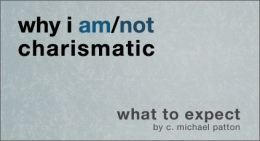
Defining “Charismatic”

By Marv

The conversation continues over at Parchment and Pen, between Cessationist C. Michael Patton and Continuationist Sam Storms. The current round aims at definition of terms, particularly asking the question: “What Does it Mean to Be Charismatic?” Each one has proposed a theory and definition, first Patton, then Storms.

Patton proposes a spectrum (graphically a wedge), in which the main players fall into the following range:

1. Hard Cessationists: These establish a category of “sign gifts” with which to box and then toss certain gifts described in the Bible. They employ Biblical and Theological arguments to demonstrate that these were always temporary, their limit being perhaps the close of the Canon or the death of the apostles.

2. Soft Cessationists: These are similar to (1) but do not object to reports of Acts-like activity from the mission field. This is what I call “long ago or far away.”

3. Continuationists: These see in Scripture (a) no indication that any gift is temporary, and (b) affirmative indications that they are ongoing. They are understood to be multi-purpose, not narrowly confined whether as a Canon stop-gap, a gospel frontier tool, or the particular property of the apostles.

4. Charismatics: These are exactly as (3) but whereas, apparently Continuationists approve passively, Charismatics pursue actively.

Evaluation:

This scale has merit, and reflects an accurate observation of the realities on the ground. The labels are problematic, however. It may be true that a theoretical, but non-practicing approver of the ongoing activity would self-identify as a Continuationist, as he/she affirms “continuation”–but would reject the label Charismatic. On the other hand, many who passionately pursue these gifts would self-identify as Continuationists, and might or might not identify with Charismatic. This is because Continuationist is a broader, more generic term. It would include Pentecostals, Charismatics, Third-wavers, and some who fall in none of these camps. Calling Patton’s category number (3) by the name of the entire set in which his (4) also falls entails a semantic error. Better to balance each side with two kinds of Cessationists on one side and two kinds of Continuationists on the other. Hard and soft? Perhaps. Passive and active? Hmm. Probably not. What this difference is does need to be further defined.

Storms picks up on the concept of pursuit, à la Paul’s exhortation of earnestly desiring the gifts (1 Cor. 14: 1, 12, 26, 39), as a key distinguishing criterion. Accordingly he sees six categories:

1. Those who don’t know what to think of the whole issue, Biblically, theologically, historically. Under this circumstance, these cannot be reasonably expected to pursue the said gifts.

2. These believe that the Sciptures positively affirm the continuation of the gifts in question. Paul’s injunction then is binding on the conscience.

3. These believe the Scriptures positively affirm the cessation of the gifts in question. Paul’s injunction is thereby obsolete, moot, and null and void for today.

4. These do not believe the Scriptures positively affirm the cessation of the gifts in question, but hold the opinion that they have ceased on other-than-Scriptural grounds or at least within a penumbra of Scriptural teaching. This puts them in the position of disregarding an explicit Scriptural injunction on the basis of rather less than explicit Biblical warrant to do so.

5. These for whatever reason hold the opinion that certain gifts mentioned in the Bible have continued while others have not. The corresponding response then would be to pursue those that have continued and not those that have not.

6. These hold either that the gifts in question possibly continue or definitely continue, and yet they do not pursue them actively. Storms points to this postion as a sin of omission.

If I understand him correctly, Dr. Storms would apply the terms Continuationist and Charismatic interchangeably to category (2), which is where he places himself.

Having distinguished the terms, he further characterizes what it entails to be Charismatic/Continuationist, as power in Christian experience and ministry and divine immanence and relational imminancy.

Evaluation:

I am not sure whether his classification system focuses on what each class actually do or what they should do. But this may simply be my reading of his meaning. In general, his basing his schema on pursuit is a helpful one, as it does seem to be–in both his and Patton’s treatments–a sine qua non of what it means to be a Charismatic. Of course, we here at To Be Continued… place ourselves in category (2) along with Dr. Storms, and so we are more likely to align with his understanding.

I would like, in summarizing, to underscore and develop briefly the important point that Sam Storms makes at the end of his post. I do not know whether he would specifically agree with me on this, but one of the reasons I prefer the term Continuationist to Charismatic is that etymologically Charismatic has to do with the concept of “spiritual gifts.” My contention is that while “gifts” is certainly a Pauline term for the particular way empowered ministry is distributed in the Body, a better center of focus for this aspect of Pneumatology is Christ’s own teaching that the Church would continue His Spirit-empowered minsitry in the same way He did it, between Pentecost and the Parousia. Talking about this gift or that gift tends, in my perception, to marginalize the topic, almost as if it were an optional add-on to the basic package, which some take and others leave.

Quite the contrary, may I suggest that Pentecost brought the church a specific connectedness, a plugged-in and turned-on direct line of communication with the Father and Son through the Spirit. That we are meant in all things, to function on-line, with constant input and output of information and power, seeing and hearing what the fallen world is blind and deaf to, acting as agents under authority–is integral equally to sanctification, communion, worship, evangelism, prayer, and the overt manifestation of divine power seen in the various “gifts.” Divine imminance, relational intimacy, ongoing revelation, miraculous ministry, efficacious prayer, passionate devotion to our Lord are descriptions of what ought to be pursued by a disciple of Jesus Christ, because they are descriptions of the manner of life and ministry of Jesus Himself.

Seeing, Eating, Working like Jesus

By Marv

Jesus’ prophetic conversation with the “woman at the well” (John 4) served as the proximate means, or at least the occasion, of the unveiling of the eyes of her heart (2 Cor. 3:15). The late John Wimber made frequent use of this account in calling Christians to understand and practice “power evangelism.” During my seminary days—pre-Continuationist, to be sure—such usage of the text was heavily criticized as misuse.

Down the hallway, at the same time John 4:35 was extolled as an important missions verse:

Look, I tell you, lift up your eyes, and see that the fields are white for harvest.

At the time I didn’t make the connection, that Christ Himself is here calling us to what Wimber called “Power Evangelism”—otherwise known as the ordinary procedure of God working through the Body of Christ to effect His works.

Jesus’ words here show us clearly that Wimber’s use of the passage was entirely correct, since He is calling us to see as He saw, eat as He ate, and work, as He worked, the works the Father had given Him to accomplish.

When Jesus told his nonplussed disciples: “lift up your eyes,” he was hardly telling them to pay more attention to their physical surroundings, lest they miss an opportunity to witness. Jesus was calling them to follow His example in how He operated. Now the second Person of the Godhead has omniscience in Himself. But Jesus was not asking His disciples to exercise their own omniscience. He constantly operated according to resources available (or that would become available) to his disciples, and to us his disciples, since He was anointed with the Holy Spirit.

His intention, the Father’s Plan, was for the church to carry on Jesus’ operating ministry after His departure from the earth. This is crystal clear from John 14:12:

Truly, truly, I say to you, whoever believes in me will also do the works that I do; and greater works than these will he do, because I am going to the Father.

Why this is true is because of Christ’s sending the Holy Spirit to anoint His Body as He Himself was anointed. The Holy Spirit has a speaking, communicational function from Christ, and ultimately the Father, toward us:

When the Spirit of truth comes, he will guide you into all the truth, for he will not speak on his own authority, but whatever he hears he will speak, and he will declare to you the things that are to come. (John 16:13)

Jesus, anointed as He was, perceived information through the Holy Spirit, so as to possess and employ knowledge beyond what his physical senses could tell Him:

And the Spirit of the Lord shall rest upon him,
the Spirit of wisdom and understanding,
the Spirit of counsel and might,
the Spirit of knowledge and the fear of the Lord.
And his delight shall be in the fear of the Lord.
He shall not judge by what his eyes see,
or decide disputes by what his ears hear,
but with righteousness he shall judge the poor,
and decide with equity for the meek of the earth; (Isaiah 11:2-4)

He saw what the disciples could not, that the woman bringing her jar to the well was elect of God and that her moment of conversion had come, that Jesus would be the messenger, and that the method would be prophetic exposure of her sinful life.

This is not alien to the expected experience of the church. Far from it. The apostle Paul urged the Corinthians to prophesy, with expectation of similar results:

But if all prophesy, and an unbeliever or outsider enters, he is convicted by all, he is called to account by all,the secrets of his heart are disclosed, and so, falling on his face, he will worship God and declare that God is really among you. (1 Cor. 14:24-25)

It was lunch time and the disciples brought back food from the village, but Jesus enigmatically said to them: “I have food to eat that you do not know about” (v. 32). They didn’t get it, of course.  He explained: “My food is to do the will of him who sent me and to accomplish his work” (v. 34).

He had been down this road before:

“Man shall not live by bread alone, but by every word that comes from the mouth of God” (Matt. 4:4). Not just every word of Scripture (since when Jesus quoted that verse, He was constrained by a direct instruction through the Holy Spirit and not by a written Bible verse), but every word communicated by the Father to His anointed worker. Just as He is calling His disciples to see as He saw, He called them to hear as He heard—and so do the work of the Father.

And this is how we work as he worked. “Truly, truly, I say to you, whoever believes in me will also do the works that I do; and greater works than these will he do, because I am going to the Father” (John 14:12). It calls for us to be in that ongoing state of open communication with Christ and the Father through the Holy Spirit by which He works through us those “good works, which God prepared beforehand, that we should walk in them” (Eph. 2:10).


The Great Non-Charismatic Trump Card

by Scott

Those who know me know I am a charismatic-continuationist. For me, at least with where I am heading in this article, this boils down to mainly two things: 1) I am committed to the reality that all gifts of the Spirit are still available to the church today and 2) I also come from a church perspective and heritage that has traditionally emphasised the importance of the times when the church gathers together in its varying ways.

But, I am also a teacher-theologian at heart. Not the most esteemed by any means. But the ministry gift of teacher seems to be the greatest measure of gifting in my calling in God.

Knowing this fact, I am continually thinking through the in’s and out’s of charismatic-continuationist perspectives and experiences. Sometimes the analysation can kick into overload.

Yet, the odd thing is that I have also experienced some very ecstatic things in my life (not always personally, though sometimes, but also with regards to others in various gatherings). I’ve reached a point in my life where nothing really shocks me. I think there are definitely some general guidelines we must take to heart as we gather together, and as a shepherd within a local church context I do consider my role of protection quite important and sobering. But, at least for me, I believe 1 Cor 14:33 has turned into the great non-charismatic trump card for many – For God is not a God of disorder but of peace—as in all the congregations of the Lord’s people.

Or other versions might say God is not a God of confusion but of peace.

What can possibly happen for some of us is that anything outside of the more normal, structured order of service can easily be seen as disorderly. And this disorder, and confusion, are definitely out of bounds. Structure and regulation carry great import, and we find that 1 Cor 14:33 provides both the grounds for our stance and the subsequent comfort in guarding against anything out of order (or weird).

Of course, in some extreme cases, this verse has been used as a manipulative tool of control. Yet, this is probably few and far between. But even as this verse provides the grounds for comfort to our structure, at times it can still cause a little too much limitation.

You see, I’m always amazed at the Corinthian situation. I mean this church was nuts. ABSOLUTELY NUTS!

There was incest, people suing one another, gluttony and drunkenness at the Lord’s table and, of course, extreme abuse of the gifts of the Spirit. Though I have encountered some difficult personal situations in my younger life as a church leader, I have not come close to the Corinthian mess with which Paul had to deal.

So one can expect a heavy hand into their situation. For goodness sake, Paul desired that people would no longer fall asleep (die) because of their disrespect for the unity of the body of Christ at the Lord’s table (1 Cor 11:30). So, when we come to things like the gathering of the Corinthian ekklesia, Paul laid out some really harsh guidelines, though, interestingly enough, he did not ever shut things down for good.

With gifts of the Spirit, we see some restrictive guidelines laid out:

If anyone speaks in a tongue, two—or at the most three—should speak, one at a time, and someone must interpret. If there is no interpreter, the speaker should keep quiet in the church and speak to himself and to God. Two or three prophets should speak, and the others should weigh carefully what is said. And if a revelation comes to someone who is sitting down, the first speaker should stop. For you can all prophesy in turn so that everyone may be instructed and encouraged. The spirits of prophets are subject to the control of prophets. (1 Cor 14:27-32)

By no means do I believe that Paul was laying out some command for all-time in that, if you have 4 prophecies come forth in your church’s gathering, then you are grieving the Spirit and disobeying God. Of course, if one doesn’t believe prophecy or tongues are still given and/or needed today, then we don’t have to worry about these instructions. But I do not believe Paul is limiting us to 2 or 3 prophecies or messages in tongues for all-time sake.

Then, following these instructive words to the Corinthians, Paul comes in with that great trump card: For God is not a God of disorder but of peace—as in all the congregations of the Lord’s people.

As long as nothing comes out of order, out of place, out of the listed structure in the bulletin (we have a bulletin, but you might have it somewhere else), we can feel safe and truly comfortable. Yet, it is interesting that one of the names of the Spirit is that of Comforter (even if we want to translate parakletos differently from Comforter, the Spirit is still a Comforter). And so I suppose we should expect to be uncomfortable at times to know the comforting work of the Comforter. Possibly even feeling a little uncomfortable as we assemble together.

But we are told we serve a God who is a God of order, of peace.

Of course he is.

But sometimes I am very aware that the order and peace of God comes in different ways than what we would expect, or command. I suppose I can remind us of a few biblical examples:

  • Isaiah walked around naked for 3 years as a prophetic action pointing out what would happen to the Egyptians (Isa 20:1-4)
  • Hannah prayed so fervently for a son that Eli thought she was drunk (1 Sam 1:9-16)
  • When Nehemiah and Ezra read the Law to the Jews, they mourned and wept (Neh 8:9)
  • Jesus had a spitting ministry, or he healed people by use of saliva, sometimes mixed with mud (Mark 7:33; 8:23; John 9:6-7)
  • Following the outpouring of the Spirit, the onlookers declared that those speaking in tongues must have been drunk (Acts 2:1-13). As a side note, the behaviour identified with drunkness was probably not the activity of tongues, since the people understood what was being said in their own language, and no one speaks in another language by getting drunk. Rather, other behaviour must have exhibited other forms of strangeness.
  • Not to mention the varied reactions during exorcisms (i.e. Mark 1:23-28; Luke 4:33-35)

You see, when we examine the spectrum of the biblical text, we see tensions right across it. That’s because differing people were writing to differing groups in differing areas at differing times. And they definitely weren’t thinking about all the details of a 21st century global world.

So when it comes to our church gatherings, we cannot easily run to 1 Cor 14:33 and state it as a stamp of approval on how we are to see the order of God come into our midst. I think it would miss both the dynamic of God and the dynamic of the Scripture text.

Of course, the biblical text tells us that God is not a God of disorder, rather he is a God of peace. But the text, that same God-breathed text, also makes clear that our God is a God of ‘disorder’ at times. Shall we survey Genesis to Revelation? Or let’s just consider the bullet points above. I think Isaiah would have made a few of us blush. I suppose spitting on someone would not be considered the most well-mannered of actions.

So when the church gathers, there is no doubt in my mind there are things that the shepherds, the elders, must consider. Again, I am involved in such week in and week out. And I have had to deal with those awkward moments. Not a lot. But I have some. But I would never give up allowing people to pray spontaneously, prophesy, burst forth in a psalm, hymn or spiritual song, share a message in tongues, weep in repentance, or shout with joy exuberant all to make sure we never ever felt uncomfortable. I believe such would be a great grievance to God’s Spirit. And we would miss out on these instructions of Paul within the same Corinthian context:

What then shall we say, brothers and sisters? When you come together, each of you has a hymn, or a word of instruction, a revelation, a tongue or an interpretation. Everything must be done so that the church may be built up. (1 Cor 14:26)

Did we catch that? – each of you has…..

Not just pastors and assistant pastors and worship leaders.

Of course everything must be done to build up. But we have to make space for such so that we can be built up.

In the end, there is no doubt that leaders are called to lead, protect, guard and wisely administrate (not in a secretarial way, but more in a leading way, as I believe the Greek word intends in 1 Cor 12:28). And sometimes we will need to bring an end to something that is causing disorder, we will have to correct, all with wisdom and grace.

But we will also, at times, need to allow for something a little ‘disorderly’ to happen that the Spirit might do the work that he and he alone can do. To stop that out of tune song, to stop the sobbing of repentance, to clamp down on prophecies, well, this could be just as disorderly than to allow for them.

I hope we can agree that there is no straight and hard line to this. But I also hope that, from now on, 1 Cor 14:33 is not simply seen as the fall back or trump card to protect us from what God might stir amongst his people in a somewhat spontaneous and unexpected way. Even if the spontaneity causes a little discomfort.

He is with us. He will lead us. He will give us discernment and wisdom. Let’s make some space for the body to be the body in our gatherings.

The Word/Message of Wisdom

by Scott

Within our local church context of Cornerstone, I have begun to pick back up on the gifts of the Spirit in 1 Corinthians 12-14. I had shared much back in the autumn time on the empowering of the Holy Spirit, as well as on prophecy and tongues. But I wanted to go back and look at the 6 other gifts mentioned in 1 Corinthians 12:8-10 – message of wisdom, message of knowledge, faith, healings, miracles and discerning of spirits.

Last Sunday I began by looking at the message of wisdom. So I wanted to post an article along the same lines.

Specifically, in 1 Cor 12:7-11, we read these words of Paul:

7 Now to each one the manifestation of the Spirit is given for the common good. 8 To one there is given through the Spirit a message of wisdom, to another a message of knowledge by means of the same Spirit, 9 to another faith by the same Spirit, to another gifts of healing by that one Spirit, 10 to another miraculous powers, to another prophecy, to another distinguishing between spirits, to another speaking in different kinds of tongues, and to still another the interpretation of tongues. 11 All these are the work of one and the same Spirit, and he distributes them to each one, just as he determines. Continue reading