
Category Archives: cessationism

On Balance

By Marv

Once the Babylonians were finished with Jerusalem, no temple remained to perform the sacrifices prescribed in the Law. But the elders of the people, taking the Scriptures wherever they went, continued to teach the Word, and this tradition continued for centuries, well after a rebuilt temple allowed resumption of sacrifices. The restored priest class, the sacrifice-makers, hugged close to the places of power, even during times of foreign hegemony–which was most of the time. Their circle, named for one Zadok (or Tsadok), became known as the Tsedukim, Greco-Latino-Anglicized as “Sadducees.” Such, in large measure, were the priests

By contrast, the teachers continued in parallel, with concentrated attention to the Law, the Prophets and the Writings. Less prone to cozy up to the Syrians, Egyptians, Romans–whatever invader happened to be in charge at the moment–many of these stressed the set-apart-ness that the Law demanded. These Separatists, Perushim, we call the “Pharisees.”

The society in which Jesus was born was rife with factions, of which the above were only two. Each side was imbalanced: the Sadducees had the cultus, but were weak on the Word, accepting only the Penteteuch, and rejecting doctrines such as the existence of angels and the resurrection. The Pharisees, by contrast, offered solidity of doctrine, but were for the most part outsiders to the functions of the Temple.

Yet, I think each group can be said to have found itself with a particular calling, the Sadducees to maintaining the worship system, sacrifices and Temple; and the Pharisees to rigorous study of and adherence to the Scriptures. That each side did so imperfectly–very imperfectly–is evident from the gospels, in which Jesus Christ–their long awaited Messiah–met with pretty much equal resistance from the two factions. But imperfect–failing though they were–Jesus affirmed their ongoing places of responsibility under God:

The scribes and the Pharisees sit on Moses’ seat. (Matt. 23:2)

“See that you say nothing to anyone, but go, show yourself to the priest and offer for your cleansing what Moses commanded, for a proof to them.” (Mark 1:44)

In the final analysis each of these is to be evaluated, not by how balanced each is, but by how faithful each is to its calling, to the particular gift given as God wills. A balance there was, however, in the form of a bipartisan chamber, the Council, known to us by its Greek name for “seated-together” synedrion, the Sanhedrin. Together in this body, the differing emphases of the priests and the teachers found equilibrium, balance.

  • Calling, gifting calls for zeal and faithfulness.
  • Body is for balance, for completeness, for interaction.

For just as the body is one and has many members, and all the members of the body, though many, are one body, so it is with Christ. (1 Cor. 12:12)

Note Paul says “Christ.” But he is talking about the Church. Who can doubt that Jesus Christ represents perfect balance in roles: Prophet, Priest, King? And in His works: Teacher, Prophet, Healer, Giver, Comforter.

We now have inherited His name, as a body, “Christ” as the apostle calls us. And we have inherited his roles:

And God has appointed in the church first apostles*, second prophets, third teachers, then miracles, then gifts of healing, helping, administrating, and various kinds of tongues**. (1 Cor. 12:28)

(**Apostles, I take to be generalists. **Tongues, I take it came in with Pentecost.)

Now we can count on the Spirit of God to keep the Body of Christ well-balanced since He  “apportions to each one individually as he wills” (v. 11). It’s when we scoop a bit out of this well-blended mixture and place it in a particular time and a particular place–a local church–that unequal distribution may occur. I don’t think the various gifts land in one-to-one correspondence with people, due to the way Paul encourages us to pursue prophecy or pray for interpretation of tongues. But it is apparent that excelling in use causes people to fall into characteristic roles: “Now there were in the church at Antioch prophets and teachers…” (Acts 13:1)

Human nature leads us to value these gifts or roles unequally. Otherwise Paul would not have to admonish us: “The eye cannot say to the hand, ‘I have no need of you,’ nor again the head to the feet, ‘I have no need of you’ (1 Cor. 12:21). We can’t, but we do.  Strength in gifting tends to have a magnetic effect; for example, a strong teacher attracts many who appreciate strong teaching.

The result is little body-lets with distorted features: one little local body of Christ has whopping great feet perhaps, and puny hands. Another Dumbo ears but tiny mouth. Imbalanced bodies; history is rife with these, maybe more the rule than the exception, and this disequalibrium is one souce of sectarian division.

Something along these lines happened, I suggest, about the turn of the twentieth century. Two different callings arose–distinct but not incompatible. Those responding to the call acted with zeal and with faithfulness–albeit imperfectly. What was lacking was balance, since, while there was some overlap, the two callings attracted followings that each tended to undervalue the other, discount the other’s legitimacy and–being disunited–fell into imbalance. In short, each said to the other “I have no need of you.”

Taking a cue from Acts 13:1, I’m going to call these two camps “Teachers” and “Prophets.” For those inclined to quibble, note I do put quotes around them. I don’t mean these terms in any absolute sense.

The “Teachers” responded to the call to contend for the Bible and the essential doctrines it teaches against a growing threat from Higher Criticism and theological liberalism.

The “Prophets” saw that a major truth of apostolic Christianity lay neglected after centuries of Church history, the power ministry through the Holy Spirit, and “spiritual gifts.”

In parallel courses, the “Teachers” produced The Fundamentals–giving rise to the label Fundamentalist. The “Prophets” saw the development of a Pentecostal movement. Again, these streams are not without admixture. For example, Pentecostals might well affirm the declarations of The Fundamentals.

Interestingly also, each one, about midcentury, fired off a kind of second stage: Charismatics and Evangelicals. Once again, I don’t wish to draw too sharp a distinction. Many Charismatics would be well cast as Evangelicals. But still two distinct lines of heritage are clearly discernable, and in many ways each of the streams tended to distance itself from the other.

My own heritage has been on the “Teacher” side, and I think I can speak with greater freedom in regard to the activities on this side of the divide. Take B.B. Warfield for example: his book The Inspiration and Authority of the Bible is a diligent and faithful defense of the Scriptures. On the other hand, his Counterfeit Miracles, laying a foundation for Cessationism, may have been intended also as support of a strong Bibliology, but uses–I suggest–a dubious Biblical argument to do it.

But the main point I want to make is this: it has become common for the “Teacher” side to characterize the “Prophet” side as imbalanced. And indeed much evidence may be given that this is the case. This charge by “my side” is regrettable for at least two reasons: first, I submit that the “Teacher” camp is also imbalanced, though perhaps in a less noisy way. Second, and more important, due to the way the Spirit has arranged the Body, my calling an opposing camp “unbalanced” may revert the responsibility back to me.

Consider two children playing on a see-saw. When one goes up, the other goes down. When that one goes up, the first goes down. It is a study in balance. Now say kid A decides to jump off, leaving kid B to fall to the ground with a thud. How meaningful is it for kid A to accuse kid B of being “imbalanced.”

If the Pentecostal/Charismatic wing of the 20th Century Church can fairly be called imbalanced–and it can–whose fault is this? Let me submit–quite irenically–from the “Teacher” stream of heritage, a main cause for it has been the “Teacher”-side invention of Cessationism–and the consequent absence of much of the Body’s stong teacher gifting from that “other” side.

I don’t mean to suggest that the “Prophets” have been teacher-less. Not at all, but all the energy that has gone into building and maintaining the (in my opinion) unbiblical position of Cessationism, could have been better spent in helping guide the stream of Pentecostalism/Charismaticism into more Biblically and theologically appropriate directions.

This is why what we see occuring toward the end of the twentieth century and the beginning of the twenty-first is so encouraging. Individuals began to arise with heritage in both streams–or coming from one learned to embrace the other. Figures such as John Wimber have been key in this regard. What was once considered an oddity, Calvinist Contintuationists such as Sam Storms, C.J. Mahaney or John Piper, are now becoming more and more common.

It is not completely clear what labels to use, if we must use labels. Some have, I think mis-characterized this union of streams as a hybridization, and it may be tempting to imagine clever terms, such as “evangematic.” But I think it is better to see some in the Church now re-reading our Bibles, welcoming the whole counsel of God, not reacting to our brothers and sisters’ failings, and taking seriously our call to pursue our giftings with zeal and faithfulness, in a way that takes seriously “our” need of “them” and “their” need of “us,” trusting God’s Spirit and God’s word to bring us into balance.
The White Dove Inn

By Marv

Three theobros, friends, colleagues, agreeing on much, differing on some things, sitting around the studio in relaxed but intelligent banter–joined together with joy, but for a serious purpose. And the podcast is ours to enjoy, to learn, to be edified by. It’s great stuff. I keep thinking though–all it needs is Rod Rosenbladt periodically saying “That’s HUGE!!!”

(If you don’t have a clue what I am talking about check out this other worthy audio theofest.)

C. Michael Patton, dean or some such title of Credo House ministries is the indefatiguable superblogger of Parchment and Pen. I admit I came for Daniel Wallace, but I stayed for CMP. Within the last couple of years he has bared his soul more than a bit, particularly with regard to his contemplation of the subject of “spiritual gifts.” In a series of eight posts he explained “Why I am not  Charismatic.” Readers of To Be Continued will be familiar with it, as with our point by point response.

Back he comes, and not alone. For a new round the venerable Sam Storms partners with CMP to provide a balancing continuationist perspective. The whole shebang starts off with this podcast, featuring Michael, Sam, and a third voice Tim Kimberley. Three DTS-grad Okies. Now that’s balance, I must say (being an Oklahoma-born DTS grad myself).

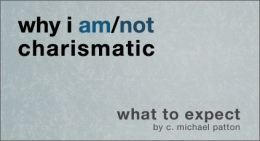
Listen to the podcast, part of their Theology Unplugged series as a bit of an intro to the discussion. The meat will be the blog posts, however, and we already have the first two: an opening salvo by Patton “Why I am/not Charismatic: My Story,” not to be confused with Storms’ “Why I am/not Charismatic: My Story.”

First course: appetizers. We digest so you don’t have to.

First C. Michael Patton’s Story:

1. Raised in non- even anti-Charismatic soil (DTS-grad pastor) Michael experienced plenty to leave a foul taste in his mouth: a church split over “the gifts,” repulsive silliness and downright abuse, embarrassing excess at a pal’s church. Charismatics behaving badly: barking, flopping, issuing inane and insipid “words,” sealed the deal.

2. MacArthurism (“Are you now or have you ever been a member of the Charismatic party?”) loaded him with Bible-based proofs to match his mood.

3. So how did a guy like him end up at a place like UBSS, which he describes as a”Third Wave” Bible college? Open prophesying, unabashing tonguing, their name was Legion, for they were many. But with Grudem as the Systematic Theology? Harvard, Westminster, Cambridge, ETS pres, Calvinist–and Charismatic. Does not compute.

4. Since then voice after voice with theological and Biblical heft have articulated and explained a cogent, coherent Continuationist understanding: Fee, Mahaney, Piper, Moreland… (Time provented him from mentioning Scott & Marv apparently…)

5. Where is he now? Standing on the edge of the chasm–the Cessationist side, underwhelmed by the arguments that keep him there, but not able (willing) to make the leap to the greener grass on the other side.

6. It is a consummation devoutly to be wished, however. With loved ones who really, really needed healing–this one is personal.

And now for Sam Storms’ story:

1. Dallas Seminary and Believer’s Chapel: meat-lovers’ milieu both, and where folk not only think, but know the Charismatic wing is full of wingnuts. Now that’s a solid foundation for a future of Cessationism.

2. It was in Oklahoma where the wind came sweeping down the plain. While pastoring in Ardmore, he read D.A. Carson, and his Cessationist pseudo-foundation crumbled under his feet.

3. He came to the realization that the Bible taught Continuationism, but he remained embarrassed by the unsophisticated, overly emotional, underly intellectual crew he’d have to associate himself with if he went with the Bible instead of his background.

4. Yet he took the plunge. Preaching through Acts, and presenting a doctrinal study on the Spirit, he led his church not only in reading about the “stuff” but doing it. Somehow he managed the paradigm shift in his congregation without the whole thing blowing up in his face.

5. Catching up with Jack Deere, whom he had known at DTS, and who had made a similar journey, Sam was renewed in the gift of tongues he had known but came to disdain two decades earlier. He eventually found himself ministering at Kansas City Fellowship for seven years–more than a small step for a man from Believer’s Chapel.

6. After a brief stint teaching at Wheaton, he returned to KC and started Enjoying God Ministries. Today he is a pastor in OKC, where, like someone else, he spends his time proclaiming the kingdom of God and teaching about the Lord Jesus Christ with all boldness and without hindrance.

We are in for a remarkable discussion, with these two. Topics foreshadowed in the podcast include:

  • Terminology: Charismatic vs. Continuationist.
  • History: Through the centuries and three “waves” in the twentieth century.
  • Distinction from Faith Movement and Prosperity Theology.
  • What about the lingo: “sign gifts,” “normative”?
  • How serious should we take things: accepting? practicing? pursuing?

Another Series – Why I Am/Not a Charismatic

by Scott

It looks like Michael Patton is rearing up for another series on why he is not a charismatic.

He has posted one before, which you can find here. The interesting thing is that Marv and I already interacted with his first series. The two of us took turns, back and forth, engaging with the varying posts from that series. If interested, you can get a copy of our series in this PDF document: Response to Michael Patton’s “Why I’m Not Charismatic”.

In this newer series of posts, Patton is adding a new aspect to it. He will now look to interact with a continuationist (this is a helpful way in today’s world for engaging in theological discussion and debate). Unfortunately, he did not choose Marv and I as the continuationist proponents. He chose the well-known pastor and theologian, Sam Storms. That’s great, and we appreciate Sam Storms, for he has allowed us to post some articles at To Be Continued. I can only imagine Sam Storms will do a tremendous job, as he does briefly in this video.

So, check out the initiation of Patton’s new series at his blog, Parchment & Pen. But also keep in touch with our interaction at To Be Continued.

Interaction with Michael Patton

by Scott

Those who follow our blog at To Be Continued, you might remember that, back in the summer, Marv and I interacted with Michael Patton’s in depth series entitled, Why I Am Not A Charismatic.

At the time, we made a PDF document available, as Michael had previously done as well. Well, rather than the previous two PDF documents being posted – Michael’s and our’s – I am now posting one PDF document that incorporates both series into the one document. So, what you have in this new document is Michael’s part 1, followed by ours, Michael’s part 2, followed by ours, etc, etc, all the way through to the full 8-part series. I believe this will allow for a better reading flow and make it easier to follow our interaction with Michael’s series.

So, for those interested, here is the link to the one PDF document that incorporates both series into one easier to follow document: Response to Michael Patton’s “Why I’m Not Charismatic”.

Seven Reasons Why I Believe the Gifts of the Spirit Still Exist Today

by Scott

This post has come out of my recent comment to Marv’s recent article, He Has Spoken Through His Son.

If it came down to why I believe all gifts of God, including those in 1 Corinthians 12 and Ephesians 4:11, still exist today, I think I could summarise it in seven specific points. So here they are:

1) God is an actual living, personal being

Almost every Christian would uphold this statement. God is a personal being and He is living. And, so, one would only expect a living, personal being to be a communicator, a speaker. This is not so much a biblical argument in which I want to specifically quote a few passages here and there (though I know we could). But it is simply a theological deduction from reading the entirety of Scripture.

Living, personal beings are communicators in so many ways. And with God Himself being a living, personal being, what else could one expect from Him? Thus, He will continue to communicate, speak, reveal, unveil, illuminate, until all things are completed. Well, and then He will keep speaking to those enjoying the blessing of the new heavens and new earth!

2) Christ is a charismatic prophet and so is his body

When I use the word charismatic, I mean it in the sense that Roger Stronstad defined it in his work, The Charismatic Theology of St. Luke (which I review here):

I use the term “charismatic” in a functional and dynamic sense. By “charismatic” I mean God’s gift of His Spirit to His servants, either individually or collectively, to anoint, empower, or inspire them for divine service. (p13)

And, as the living Word, Christ was the greatest Prophet to ever exist (as I share more here at my personal blog). There has been none like him who spoke and revealed the Father, for he taught us that whoever has seen him has seen the Father (John 14:9).

Therefore, if Christ is the great charismatic prophet, then by nature, his body is to follow in his footsteps. The body follows the head. It’s part and parcel to our calling in Christ. It doesn’t mean that everyone is particularly marked out as a prophet today. Of course not. But, via the Holy Spirit’s indwelling and empowering, Christ expects his body to get on with completing that which he initiated. Christ is still continuing that which he began to do and teach (Acts 1:1). Thus, we are now not only a priesthood of all believers, but also a prophethood of all believers.

3) The Spirit continues the same work of Christ

This really connects with the former point, but it is the Spirit that is the main one to continue the work of Christ. It is the Spirit that comes to indwell and empower the people of God here and now. We are the vehicle by which Christ continues his work via his Spirit.

I know this sounds like the A, B, C’s of pneumatology (doctrine of the Holy Spirit). But when one reads the pervading teaching about the Spirit of God throughout the Scripture, and especially noting the heightened teaching and activity in the NT, one receives the overwhelming sense that the Spirit that was sent at Pentecost was to continue acting in accordance with his nature as recorded in the OT and NT until that final parousia-return. Again, the basics on pneumatology, but the same Spirit that was actively at work in the first century was to continue to indwell and empower the body of Christ for the past 1900 years and counting.

4) The positive affirmation in Scripture that such gifts would continue

I share much more here for you to read on this, but suffice it to say that there are actual Scripture passages teaching that such works and gifts would continue. In the article I have linked to, I specifically take time to look at these four positive Scriptural affirmations: John 14:12; Acts 2:17-18; 1 Corinthians 13:8-12; and Ephesians 4:11-16.

There are plenty more one could look at and consider, but those are a very solid starting point as to specific passages.

5) Faulty exegesis of the normal passages brought up by cessationists

By no means do I want to sound arrogant, but there are the ‘usual suspects’ brought up by cessationists as pointers to why certain gifts (or ‘sign gifts’) would cease once the full testimony of the gospel and new covenant was finished in the completed canon of NT Scripture. While I uphold the importance and authority of the Bible, I strongly believe none of Scripture points to the ceasing of any gifts prior to the parousia-return of Christ.

Four very often quoted passages are 1 Corinthians 13:8-12; 2 Corinthians 12:12; Hebrews 1:1-2; and Hebrews 2:3-4. I have spent some time considering these passages in this article. So rather than dealing with them in depth here, you can follow the link and read my thoughts.

As a side point, it is also quite interesting to note that phrases like ‘word of the Lord’, ‘word of God’, or ‘word’ do not always refer to the graphe written Scripture. God spoke His word and always has spoken His word. Again, it’s part and parcel to be a living, personal being that desires to communicate with those He created. But here are some examples where the above mentioned phrases are not referring to Scripture:

  • Word of God – Luke 3:2
  • Word of God – Acts 4:31
  • Word of God – Acts 6:7
  • Word of God – Acts 12:24
  • Word of the Lord – Acts 13:44, 48-49
  • Word of the Lord – Acts 19:20
  • Word of the Lord – 1 Thess 1:8
  • The are countless times the word ‘word’ arises and does not refer to Scripture

6) The amount of times God actually spoke through and used those who were not prophets or apostles

Here is a smattering of examples just from the New Testament:

  • Stephen (Acts 6:8)
  • Philip (Acts 8:4-7)
  • Ananias (Acts 9:17-18)
  • The 120 believers at Pentecost (Acts 2:4)
  • Cornelius and his household (Acts 10:46)
  • Agabus (Acts 11:37-38; 21:10-11)
  • The Ephesian disciples (Acts 19:6)
  • The Galatian believers (Gal 3:5)
  • The Corinthian believers (1 Cor 14)

This should give us courage who are not actually apostles or prophets. God wants to utilise His people in such ‘charismatic’ activities since He has been doing such from the beginning.

7) The great testimony of the charismata in church history

I have already written on this topic before, as you can see here. But suffice it to say, there are plenty of examples of God, by His Spirit amongst His people, speaking and acting out the charismata as found in 1 Corinthians 12.

And, a great resource to look at would be The Century of the Holy Spirit: 100 Years of Pentecostal and Charismatic Renewal by Vinson Synan. He takes time to chronicle what has happened over the past 100 years or so with the rise of the Pentecostal and charismatic movements. In today’s world, it is highly probable that there are some 500 million believers associating themselves with either Pentecostal, charismatic or neo-charismatic churches. And the accounts of God’s activity by His Spirit continue on into the 21st century.

So, suffice it to say, I find it extremely hard to argue for the cessation, or ceasing, of the gifts of the Spirit. For me, there is an overwhelming biblical, theological and historical positive case for the continuation of such.