Tag Archives: Holy Spirit

Two Books and an Interview About the Holy Spirit

by Scott

Over at Between Two Worlds, blog of Justin Taylor, he recently posted an article that tells of two books on the Holy Spirit by author Graham Cole. Cole is currently professor of biblical and theological studies at Trinity Evangelical Divinity School.

The two books are He Who Gives Life: The Doctrine of the Holy Spirit (which is a more theological work) and Engaging with the Holy Spirit: Real Questions, Practical Answers (which is a more accessible book to all people).

It seems Cole is more of a cessationist, but his book receives a positive recommendation by C.J. Mahanney (a continuationist) for both books.

But, more interesting on Justin Taylor’s blog is a short interview between him and Cole. There are four specific questions discussed, but I thought this one about the Spirit’s filling in Ephesians 5:18 presented some good things to chew on.

———————————–

We are commanded to “be filled with the Spirit” (Eph. 5:18). How do we do that?

A great question!

The first thing to notice is that Ephesians 5:18 is addressed to a congregation.

Next, it may be translated “Be filled by the Spirit!” In fact, in context Paul is contrasting the sort of behaviors you see in a pagan assembly (e.g., drunkenness) and what is to characterize a Christian one (e.g., making melody in your [plural] heart [singular] to the Lord and submitting to one another out of reverence for Christ).

In my view, it is not about power for service for the individual. We obey this command when our Christian meeting is filled by the Spirit with these kinds of practices. Then we truly are the temple of the Holy Spirit that Paul speaks of in Ephesians 2.

However, Paul specifies no steps. So what’s the way forward? I suggest Acts 4 provides a paradigm case. These early Christians gathered in the face of persecution and prayed for boldness to proclaim the gospel. Interestingly they did not pray to be filled with the Spirit. And what did God do? He filled them with the Spirit and they spoke boldly indeed. So I would counsel if you want to be filled with the Spirit, set your heart and life prayerfully on the next step of Christian faith and obedience and you will be filled with the Spirit.

Back to Ephesians 5. When we as a congregation prayerfully fill our meeting with the practices set out in Ephesians 5:19-21 we can trust that our assembly really is the temple of the Spirit. In these practices the focus shifts from me to the Lord, and my brothers and sisters.

———————————–

Click here for the rest of the article at Between Two Worlds.

Is That What History Really Teaches Us? (Response to CMP, part 5)

By Marv

This post is part of a series responding to C. Michael Patton’s eight-part series at Parchment and Pen “Why I am Not Charismatic,” which is also conveniently available for download as a single e-book here. This is in response to part five.

Michael,

The unspoken premise behind your historical argument is that over the centuries the church has looked pretty much the way Jesus intended.  Really?  Anything that goes missing, then, is like the dog that didn’t bark, prima facie evidence that the thing has dried up at the source.  It is something that God just isn’t doing any more.  Once we start playing that game, however, it is difficult to know when to stop.

There are a number of ways to respond to your part five, “An Argument from History.”  As for your specific citations of Chrysostom and Augustine, Scott has countered these quite handily in an earlier post here.  Jesse Wisnewski makes a similar argument at Reformed and Reforming here, and also makes the observation here that it illustrates the fallacy of an argument from ignorance.  Then there’s the point that you take us on a snipe hunt for the elusive “supernatural sign gifts”, showing that if you set your definitions and expectations just right, you can be assured of coming up empty handed.  This is your own “glaring weakness” in commenting on about Jack Deere’s argument, where you say:

He equates evidence that the historic church believed in the miraculous with evidence that they were continuationists. You can’t equate the two without misrepresenting what is at stake.  The historic Christian church has believed in the miraculous, they have not believed in the continuation of the supernatural sign gifts, by and large.

On the contrary, Michael, I’m afraid it is you who have misrepresented the situation by insisting on your own minimalist definition.  Continuationism in the first place is not about “gifts” but that Jesus Christ:

…continues His work of glorifying His Father, building His Church, and advancing His Kingdom through the ongoing, vital and dynamic interconnection He maintains with those who are in Him, accomplished through the empowering presence of the Holy Spirit…

From my earlier post “What Continues?

This empowering presence is referenced in a number of forms such as prayer in Jesus’ name (John 14:13-14), the prayer of faith for healing (Jas. 5:15), and signs and wonders (Acts 4:30).  The phenomenon that this empowerment is parceled out through the different members of the body gives rise to the concept of “gifts” (1 Cor. 12:4).  Parallel terms here include “service,” (v. 5), “activities” (v. 6), “manifestations” (v. 7).  Elsewhere they are called “distributions” (Heb. 2:4, though typically translated “gifts”).

Isolating the term “gifts” only serves to distort the issue, particularly when pared down to the scripturally dubious category “sign gifts.”  This category serves as a nice sharp container where the used, hazardous and unwanted bits may be safely disposed of, but it is not only absent from church history, it doesn’t even appear in the Bible (more here.)  And I’ll have more to say as I respond to your part seven.

I want to take a somewhat different tack, however, in responding to your argument from history.  As I suggest in my first paragraph, the same kind of disappearing act occurs with other aspects of apostolic teaching, and I don’t think you, at least, would see these as evidence God is no longer doing that sort of thing.

1.  Salvation by grace alone through faith alone.  It is amazing how the sharp edge of this central apostolic truth goes blunt shortly after the death of the apostles.  The Shepherd of Hermas, for example (ca. AD 150), which is listed among the “Apostolic Fathers” proclaims that once you are baptized, you can sin and repent only one time (Mandate 4, chapter 3).  If this were true, we’d all be toast, of course.  Thank God for the butter of His grace!

We again pick up a clear understanding of grace with the Protestant Reformation, but what are we to say about the intervening centuries?  The truth wasn’t completely absent, but unmixed expressions of it are scarce for several centuries.  We now have some five centuries since the doctrine’s recovery, but do we conclude that in the interval God had withdrawn sola gratia?

2.  Believer’s baptism.  Speaking of baptism, I understand your ministry statement of faith is deliberately short and broad, but I think you personally hold to believer’s baptism by immersion, if I am not mistaken.  At any rate, I think this was the “normative” apostolic practice, but it did not fare so well in the history of the church.  Even the Protestant Reformation largely did not restore this, except in what some would designate as “fringe groups and cults.”  Some really do argue for de facto paedobaptism from the course of history.  Would you?

3.  Premillennialism.  Understand that I am directing this specifically to you, Michael.  A number of people will not agree with this point, including Scott, but it is given as an example.  I believe you hold that the apostolic hope was premillennial, but that this understanding disappeared for the most part early in church history.  It had a resurgence around the nineteenth century.  So in the sweep of history, it is not that different from the time frame you attribute to continuationism, which you say was not “in any way normative before the twentieth century.”

This historical premise is definitely used by some as an argument against premillennialism.  What about you?  Are you a de facto amillennialist?

So what do we really learn from history?  Don’t we end up proving a little too much if we take your approach?

These are just a few of examples.  You could probably suggest any number of reasons why particular doctrines or practices ceased to be “normative” over the years, without suggesting that God was “no longer doing that.”  Indeed, we ought to exhaust every other possibility before going with that option.  Ignorance?  Tradition?  Clerical status?  Biblical illiteracy?  Misunderstanding?  Distortion over time?  Fear?  Disbelief?  Poor leadership?  Politics?

The church is often likened to a ship.  Over the years wooden sailing vessels require periodic maintenance.  Their bottoms becomes fouled and their wood suffers from rot.  The barnacles need to be scraped off and the original woodwork restored.  Unfortunately, some of our ecclesiastical institutions of long standing over time became in many ways more barnacle than timber.

From time to time more extensive refits have been necessary. The best known is probably the Protestant Reformation, which largely focused on soteriology.  Today, I humbly suggest,  it is time for recovering apostolic pneumatology.

Semper reformanda.

The Spirit of Jesus and the Works of Jesus

by Scott

I believe that one of the most essential things to grasp in regards to our understanding of the Holy Spirit is that the Holy Spirit is the Spirit of Jesus Christ.

What do I mean?

Well, for many, especially specific groups that might be identified as sects or cults, they only recognise the Holy Spirit as the Spirit of the Father. And, because of this, they de-personalise Him simply recognising that He is a kind of extension of God the Father, His power-force at work in the earth.

Such theology might remain in tact if we only had the Old Testament on which to build our theology. But one important pneumatological aspect the New Testament shows us is that the Spirit is the Spirit of Jesus. I believe this has bearings on two major theological areas: 1) the personal nature of the Holy Spirit and 2) the divine nature of Jesus.

The Spirit is no longer simply identified as the Spirit of the the Father, but also of Christ. And I believe this comes against the notion that He is simply a force (though there are points to consider with regards to the Spirit’s personality). And this also indicates what kind of nature Christ has, the divine nature just like the Father, since the Holy Spirit is His Spirit as well.

But where does Scripture identify the Holy Spirit as the Spirit of Jesus?

And when they had come up to Mysia, they attempted to go into Bithynia, but the Spirit of Jesus did not allow them. (Acts 16:7)

And because you are sons, God has sent the Spirit of his Son into our hearts, crying, “Abba! Father!” (Galatians 4:6)

For I know that through your prayers and the help of the Spirit of Jesus Christ this will turn out for my deliverance. (Philippians 1:19)

And it is important to also look at Jesus’ discourse on the Spirit in the whole of John 14-16. Though the Father would be sending the Spirit (i.e. John 14:26) we also see that Jesus taught that He would, likewise, be the sender of the Spirit from the Father:

But when the Helper comes, whom I will send to you from the Father, the Spirit of truth, who proceeds from the Father, he will bear witness about me. (John 15:26)

Nevertheless, I tell you the truth: it is to your advantage that I go away, for if I do not go away, the Helper will not come to you. But if I go, I will send him to you. (John 16:7)

There is a differentiation from the Father, though not a complete disconnect, and a distinct connection of the Spirit with the Son. This is crucial within the Trinitarian framework.

But why such an emphasis on Jesus’ sending of the Spirit and the Spirit being identified as the Spirit of Jesus? Because the Holy Spirit, the Spirit of Jesus, would continue the exact same work that Jesus initiated upon His arrival. This is why Jesus could say: I will not leave you as orphans; I will come to you (John 14:18). And Luke could start out his second volume, Acts, with these words: In the first book, O Theophilus, I have dealt with all that Jesus began to do and teach.

The Spirit Himself, who was both the Spirit of the Father and Son, would be sent to continue the work that Jesus was sent to originally do. But whereas the work of the Son was limited in His incarnation, the Spirit would now indwell and empower the entire company of God’s people to accomplish the same ministry and works of Jesus. Going back to John:

Truly, truly, I say to you, whoever believes in me will also do the works that I do; and greater works than these will he do, because I am going to the Father. (John 14:12)

Now, I am aware of what I might term as the ‘selective group’ argument and the ‘time limit’ argument. What do I mean by these two terms?

Well, the ‘selective group’ argument states that these words of John 14:12 were only expected of the original twelve. But I’m not sure that is a very defendable position and we could simply start by pointing out that the verse utilises these words: whoever believes in me. But, maybe for some, it’s not as simple as that. So let’s move on.

Here is where the fallacy lies for some with regards to John 14:12. When we think of the ‘works of Jesus’ from this passage, at least for many, they jump to think specifically of healings and miracles. Of course, this passage does teach that those who believe will do greater works. But I don’t believe this is a qualitative statement, but rather a quantitative statement, since you can’t get much greater than the Son of God Himself in all His varied works.

Thus, some make that ‘jump’ that identifies the ‘works of Jesus’, at least in the context of John, as healings and miracles. Now, the works of Jesus do include healings and miracles, but they also include proclamation of the gospel of the kingdom, mercy on the poor in spirit, compassion for the hurting, washing feet of our sisters and brothers, loving our enemies, words of knowledge, lovingly touching the outcasts, and so much more.

So, here is the point. There really is no ‘selective group’ in regards to the varied works of Jesus. We have got to stop identifying this statement as only referring to the ‘sign gifts’ or whatever we want to term them. This statement is much broader than that. It goes across the board with the works of Jesus.

But, if we want to reduce this statement to such specific acts of healings, miracles, signs, wonders, etc, then we have to recognise that quite a few others were used in just these such things beyond the twelve. Such examples are:

  • The 120 believers at Pentecost (Acts 2:4)
  • Stephen (Acts 6:8)
  • Philip (Acts 8:4-7)
  • Ananias (Acts 9:17-18)
  • Cornelius and his household (Acts 10:46)
  • Agabus (Acts 11:37-38; 21:10-11)
  • The Ephesian disciples (Acts 19:6)
  • The Corinthians believers (1 Corinthians 12:8-10; ch.14)
  • The Galatian beleivers (Galatians 3:5)

And by no means is that a complete list, nor if we listed every single biblical instance of these following Christ’s ascension does that mean that we have then identified every such act. Even Jesus did a lot more than was recorded in Scripture (John 20:30-31). I expect the same was true of His followers.

But one final note connecting back to the original passage quoted from John 14:12. Read the rest of John 14-16, since that is the fuller context. For those who want to argue that Jesus was only speaking to the twelve, notice how many times the language is much larger than the twelve, referring to the whole company of believers to come. Do we not see even these words below as relevant to us today?

13 Whatever you ask in my name, this I will do, that the Father may be glorified in the Son. 14 If you ask me anything in my name, I will do it. 15 “If you love me, you will keep my commandments. 16And I will ask the Father, and he will give you another Helper, to be with you forever, 17even the Spirit of truth, whom the world cannot receive, because it neither sees him nor knows him. You know him, for he dwells with you and will be in you. (John 14:13-17)

Now I am quite fine to identify that Jesus was initially speaking to the twelve. But did Jesus expect all of these words to stop there? Can we really invest in the belief that this was for twelve and the twelve alone?

Ah, but what about the ‘time limit’ argument. Many will easily recognise that others in the ‘New Testament times’ were being used in such gifts of the Spirit. But sometime at the turn of the second century, possibly following John, the apostle’s, death, some of these Spirit-gifts came to an end. They had exhausted their purpose, at least their purpose for being normative in the life of the church.

But again, this thinking is very reductionistic. Why would we expect some portion of Jesus’ ministry to continue, say two-thirds or three-fourths or even 95%, but not all of it? Oh, I know the many arguments from varying passages and theological perspectives. And I guess I cannot address every twist and turn of the cessationist perspective here in this short post. But do we really expect any part of Jesus’ ministry to have ended? Or do we really expect any part of Jesus’ ministry to have become ‘non-normative’? Mercy and teaching and gentleness are for the regular life of the body. Prophecy and healings and words of wisdom are not. Huh?

Remember, Luke started off his volume two by saying his volume one recorded all that Jesus began to do (Acts 1:1). So Acts kicks off with an expectation for things to continue and you have a church launching out into the works, all the works, of Jesus. They stepped out with mercy, compassion, serving, prayer, praise, teaching, evangelism, prophecy, healings, miracles, and even something Jesus probably never participated in, tongues and interpretation.

Remember, the Spirit who is activating these very works, again, all of these works, is the very Spirit of Jesus. You could expect nothing less, absolutely nothing less than the exact things Jesus walked in. Why? Because this is the Spirit of Jesus Christ. It’s really as simple as that.

Jesus comes doing the things of the Father (John 5:19). He even announces that if you’ve seen Him, you’ve seen the Father (John 14:9). And so the Spirit comes initiating in Christ’s people the exact same things that Jesus started out with. And so the church, empowered by the Spirit, should be able to state, ‘We only do the things that Jesus did. If you have seen us, you have seen Jesus.’ If only that were our testimony more regularly.

And this is across the board. Not just with the fruits of the Spirit, but also with gifts of the Spirit. Not just with ‘signs and wonders’, but also with serving and washing feet.

The Father and Son sent the Spirit for a purpose. To help empower the entire body of Christ to accomplish the entire work of Christ across the entire planet. At times, it will involve laying our hands on the sick and seeing them restored. I remember a friend of mine who laid his hands on another young man’s hands that were filled with warts. He asked in Jesus’ name for the hands to be cleared, and when he removed his hands following the prayer, there was not a trace of warts. It softened that young man’s heart. But at times, it will involve serving a bowl of hot soup to a hurting and homeless refugee with a word of kindness. Both communicate the heart of Jesus. Both are wrapped up in the works of Jesus.

So let us look to see the Spirit of Jesus Christ Himself empower us to serve with the works of Jesus, however that may look today and tomorrow. We have a mission to accomplish and we will not complete it effectively apart from the Spirit’s work. We will not walk in the works of Jesus, in all their varied aspects, without the Spirit of Jesus Himself.

The Use of Luke-Acts For Developing Our Pneumatology

by Scott

When it comes to developing our pneumatology, or our theology of the Holy Spirit, there has been much discussion on whether or not we can utilise the Gospel of Luke and the book of Acts to inform our understanding. Honestly, some have not been keen on the idea of utilising Luke-Acts, since they would see it as more descriptive rather than didactic (teaching doctrine). Such a group would see the epistles (i.e. Paul’s letters) as the primary didactic source for our pneumatology and the descriptive parts (such as Luke-Acts) as secondary in teaching doctrine.

So, is it worth utilising Luke’s words in both his Gospel and Acts as a primary source for developing our theology of the Holy Spirit? Or should Luke’s two-volume work be seen more as a secondary pneumatological resource?

There are a couple of points I believe that are worth noting:

Luke as Both Historian and Theologian

An important thing to notice is that Luke stands as the only recorder of the early church and its history. Other Gospels (3 of them) had been written alongside Luke’s. But he alone holds a unique position as presenting early church history. It leaves us asking if his words should be relegated as secondary to the epistles or if they will give us a better understanding of the Spirit of God and His work.

If we are honest with the text, and note Luke’s pneumatological purpose in his recording of early church history, Acts does stand as a vitally important theological work. And its significance is especially heightened when studied with its preceding volume, the Gospel of Luke, as Luke emphatically highlights the work of the Spirit in the life of Christ.

So, whereas in the past, many evangelical theologians would have not seen the benefit of developing doctrine from narrative portions of Scripture, there has been a much great acceptance of such in recent years. This is a very important recognition, for we can definitely learn from narrative parts. We can learn just as much from God’s deeds as we can learn from God’s words. Even more, this inspired account of early church history is where theology and doctrine are being walked out in daily life. Thus, it carries importance. This is why I believe that Luke must be respected as both historian and theologian.

Below are a few passages showing how we can receive instruction from the historical recordings of Scripture.

For whatever was written in former days was written for our instruction, that through endurance and through the encouragement of the Scriptures we might have hope. (Romans 15:4)

Now these things happened to them as an example, but they were written down for our instruction, on whom the end of the ages has come. (1 Corinthians 10:11)

Yes, it is definitely true that Luke presents a descriptive history of the church in his second volume, Acts. No one can argue with such. But, what we must be willing to recognise is that it is a didactic history at the same time. There is no doubt that Luke wrote to teach. He did not only write to describe, he wrote with a purpose to instruct us, just as the writers of old would have done with their narrative portions of the Old Testament text.

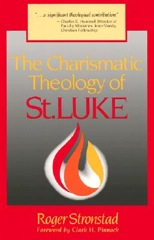
As theologian Roger Stronstad reminds us:

‘If for Paul the historical narratives of the Old Testament had didactic lessons for New Testament Christians, then it would be most surprising if Luke, who modelled his historiography after the Old Testament historiography, did not invest his own history of the origin and spread of Christianity with a didactic significance.’ (The Charismatic Theology of St. Luke, p7)

Not only that, but we have these oft-quoted words of Paul:

16 All Scripture is breathed out by God and profitable for teaching, for reproof, for correction, and for training in righteousness, 17 that the man of God may be competent, equipped for every good work. (2 Timothy 3:16-17)

Paul envisioned all parts of Scripture as God-breathed and useful for teaching. To say that certain portions of Scripture take precedence over others is not easily established from Scripture itself.

Luke Speaks For Himself

What I mean with this subheading is that, many times, theologians will try and squeeze Paul’s specific theological emphases into Luke’s theology. Thus, we end up reading Luke through a Pauline lens, which is not at all helpful.

Of course Scripture presents a harmonious whole. There is a unifying structure and nature to the entire text. But we need to give room for Luke to speak as Luke, rather than try and make Paul’s words fit into Luke’s words (or vice versa). For Luke is himself trying to teach us something about the Messiah, the mission of the church, the work of the Spirit, and a whole lot more. Let’s give this man room to teach us, even teach us apart from Paul’s own words.

Even more interesting, when it comes to the baptism and filling of the Holy Spirit, Luke speaks about these two issues many more times than Paul ever does. Consider these statistics:

  • Baptised in the Spirit: Luke 3 times; Paul 1 time
  • Filled with the Spirit: Luke 9 times; Paul 1 time

Not only that, but Luke utilises a lot of different phrases to describe these similar actions: the Holy Spirit came upon; the Spirit was poured out; the gift of the Holy Spirit; the Spirit fell on people; people received the Spirit. If we take all of these into account with regards to being baptised and/or filled with the Spirit, Luke has a lot to contribute on this topic. Our ears should be tuned to this man’s words.

Stronstad shares some more insights:

‘Consequently, just as the recognition that Luke is a theologian as well as a historian makes Luke-Acts a legitimate data base for the doctrine of the Holy Spirit, so the recognition that Luke is independent of Paul will broaden the New Testament data base for the doctrine of the Holy Spirit. To recognize these two facts is to rehabilitate Luke as a historian-theologian of the Holy Spirit and to allow him to make a significant, unique, and independent contribution to the doctrine of the Holy Spirit.’ (p11)

Thus, I agree wholeheartedly with this final statement of Stronstad:

‘On the one hand, where it is appropriate, all parties in the current debate must abandon those largely self-serving methodological programs which conspire to either silence or to manipulate Luke’s distinctive theology. On the other hand, all parties must develop a methodological consensus for interpreting the gift of the Spirit in Luke-Acts. At a minimum, this consensus must include the following principles: 1) Luke-Acts is theologically homogeneous, 2) Luke is a theologian as well as a historian, and 3) Luke is an independent theologian in his own right.’ (p12)

And just as a side note, another great work on how Luke should be viewed as not only historian, but also theologian, is I. Howard Marshall’s Luke: Historian & Theologian.

As we look to develop a holistic pneumatology, consistent with the full text of Scripture, we must not forget Luke’s words and set them aside as only secondary to the words of Paul. Of course, we must also not pit Luke and Paul against one another, noting they were part of the same ministry team at times and are both within the canon of Scripture. But Luke’s words will, no doubt, enrich our understanding of the work of the Holy Spirit. All we must do is allow for them to teach us.

The Prophetic Body of Christ

by Scott

The gift of prophecy is not some arbitrary gift given to the church so that we can sound super-spiritual and have goose-bump experiences. The gift of prophecy is given for a reason, for a purpose.

There is one major practical reason that prophecy is given to the church, which is stated this way by Paul:

On the other hand, the one who prophesies speaks to people for their upbuilding and encouragement and consolation. (1 Corinthians 14:3)

Prophecy will bear fruit when it is spoken – fruit that will bring edification, encouragement-exhortation, and comfort. It might also challenge, but that challenge, if heeded as God’s word, will still stir these three characteristics in the life of the believer. It can cause a fog to clear, despair turn to hope, deep worry resolve to peace, and much more.

But, while this is a major outcome of Spirit-directed prophecies, there is still yet a greater reason as to why prophecy is still given to the church today. This might sound over simplified, but it breaks down into these 3 points:

  • As the very Word of God, Jesus was and is the great prophet of human history.
  • The Holy Spirit was sent in His stead to continue the work of Jesus, including His prophetic work.
  • The Holy Spirit is given to the church so that they may be all of Christ in the world today, even the prophetic Christ.

In a simplified manner, that is how it plays out. Jesus >> Holy Spirit >> Body of Christ.

Jesus is the proto-type of every ministry within the body of Christ, from prophecy to mercy to teaching to shepherding to giving to healings to whatever ministry might come forth. Though it might sound somewhat cheesy, we really are called to start with Jesus as to the great example of every ministry made possible to God’s people.

And this is the key to making sure His ministry would continue: Jesus promised to send another Parakletos in His name, even the Spirit of God. That was the plan way back when.

I have always loved these words of Jesus:

Nevertheless, I tell you the truth: it is to your advantage that I go away, for if I do not go away, the Helper will not come to you. But if I go, I will send him to you. (John 16:7)

It was to our advantage that Jesus went back to the Father? Huh?

Yes, for in doing so He could send the Spirit that could now indwell and empower the whole body of Christ, not just a few select individuals. This was the cry of Moses centuries before Christ stepped onto the scene and promised His Spirit:

Would that all the LORD’s people were prophets, that the LORD would put his Spirit on them! (Numbers 11:29)

And, so, when the Spirit was poured out on all flesh – male and female, young and old – this was what the ‘special’ prophets had been longing for and what THE prophet had promised. Peter has a revelation himself at Pentecost that what they were viewing and hearing was a fulfilment of the words of the great prophet, Joel:

17 “‘And in the last days it shall be, God declares, that I will pour out my Spirit on all flesh,and your sons and your daughters shall prophesy,
and your young men shall see visions,
and your old men shall dream dreams;
18even on my male servants and female servants
in those days I will pour out my Spirit, and they shall prophesy. (Acts 2:17-18; from Joel 2:28-29)

The very Word-of-God-become-flesh promised to the give the very Spirit of God to His people. What a fantastic idea! For how could the body of Christ actually be Christ without His Spirit? How could we be Christ to one another and a hurting world if we did not have His indwelling and empowering Spirit? Well, we simply could not.

And, if the very Spirit of God was given by Christ to His church, would He expect anything less than for us to continue in all the varying ministries He Himself walked in? I cannot imagine such. The very Spirit of God who empowered the incarnate, fully human Son was also given to empower the current incarnate Christ in His fully human body, if you will. The hundreds of millions that make up Christ’s body today are Christ incarnate today. That’s exactly how He meant it. And Jesus knew that the best way to help us be Him in the world is to give us the same Spirit that empowered Him as a human man.

It truly is a marvellous plan.

So, in a much bigger sense, the gift of prophecy, while it is a blessing to us and we are strengthened by it, is given that we might continue the full work of Christ. And, again, every single ministry gift given has been given so that we might continue in the full work of Christ.

Thus, we find in this one of the main purposes of the Spirit of God being given to His church. It would not just be fine and dandy for Christ to charge us to continue His work without supplying and equipping us with His Spirit. We would have failed pretty miserably (though sometimes we do in the midst of such a provision). So, as the Father sent the Son, the Son now sends the Spirit. Quite a team.

This was to our advantage because, as a human-incarnate man, Jesus was only able to do so much by Himself. He touched many lives, but it was still limited as a human. But He knew that, as the exalted Christ, He could send His Spirit to empower literally billions down through the centuries to finish what He started.

This stirs me even now to complete His work, to catch the prophetic heart of Christ as I gather with the saints, have conversation with friends, and meet with the varying peoples that God brings into contact in my life. To have an ear attuned to what He might say, to speak it forth, and see it come as a kind of two-edge sword into the lives of people. This is a privilege.

But more than that one moment, we start to the get the sense that we are participating in something far larger than our tiny selves. We are walking out the very ministry of the Lord of heaven and earth. And, in doing so, we can be certain that we will see and taste the fruit of edification, encouragement, exhortation and comfort in the midst of prophecy. And that fruit will taste very sweet.

So, let us keep in mind that Christ has and always will desire that His body be a prophetic people. No gender barriers, no age barriers allowed, a true reality of the age of the Spirit. And we can, by the Spirit of God, speak forth the words of God that call people to be drawn in to the bigger purposes of God, the redemptive purposes of the kingdom of God. This stirs me deeply.