Over at the blog of Mark Roberts, he recently posted a 3-article series on prophecy in the book of 1 Corinthians. It was refreshing to see a Presbyterian pastor-theologian advocating the continuation of the gift of prophecy today. And, of course, this was interesting as I just began posting a series on prophecy as well.
You can read all three posts by clicking on these links:
On Sunday at Cornerstone, after a few weeks of visiting speakers, I continued on from my introduction to the gifts of the Spirit. I began what will be a two-Sunday series on the gift of prophecy, maybe something like seminars entitled Prophecy 101 and Prophecy 102.
You can listen to the message by clicking on the icon below, or you can download from Cornerstone’s podcast site or iTunes.
For those interested, the major thrust of my message can be found in the article below.
There are five terms I specifically discussed:
1) Revelation
At times, in discussing this word amongst varying Christians, there are two unhelpful perspectives that I believe can arise from the term revelation. They are as follows:
a) Super-scary
This comes with regards to some ideas about the book of Revelation. The Greek word for revelation is apokalupsis, and it’s where we get our word apocalypse. And that word apocalypse brings up all sorts of unhelpful images, with a special thanks to Hollywood in recent decades.
Oddly enough, the word apokalupsis or revelation simply means an unveiling or an uncovering. As an illustration, it’s quite like being present at a theatre play and awaiting the beginning scene of the play. The curtains are drawn closed and everyone is chattering away with anticipation of the opening scene. And, at the first sound of the pit orchestra, the curtains open and the crowd sees the beautiful and intriguing set designed on stage, the cast of characters beginning with a great dance, etc. With that, we just had an unveiling, an uncovering.
The same is true of God’s revelation. When God reveals, He is pulling back the curtain, if you will, for us to see.
b) Super-spiritual
Some Christians hold that God is no longer revealing Himself (they might term it as no more ‘special’ revelation) because we now have all of God’s revelation fully and finally recorded within the canon of Scripture. The Bible is the final measuring stick for the beliefs and practises of the church and, thus, God no longer speaks and specifically reveals Himself. But I have three minor points to bring up about God revealing Himself today.
a) No new redemptive revelation.
I would agree with just about every evangelical Christian that God is no longer bringing forth new redemptive revelation. To claim such is dangerous. Well, it’s heretical. We believe that Jesus Christ and his work alone is the final word on God’s redemptive plans for all peoples. To that, there is nothing to add. As Paul said, if we preach another gospel than the finished work of Christ and, well, one will be cursed (Gal 1:8-9).
b) God has always been speaking and acting outside the Bible.
As I always make sure I communicate, I recognise that the Bible stands as the measuring stick for our faith and the practice of our faith. And, within the the text, we find a very thorough account of all God has said and done from the beginning until the first century. We truly know this is God’s inspired word.
But, of course, the Scripture does not record every word and act of God, does it? A couple of small examples are found in 1 Sam 10:10-13 and 1 Tim 1:18-19. In the first, we find Saul empowered by the Spirit prophesying amongst a group of prophets. What they said was not recorded in Scripture. But there is no doubt that, as prophecy, it would have been Spirit-inspired utterance. In the second example, we read of Paul reminding Timothy of the prophetic words that were made about him and that ‘by them you may wage the good warfare, holding faith and a good conscience’. In both situations, we would have found Spirit-inspired prophecy. But in neither case do we find those prophetic, and revelatory, words recorded in Scripture. The event is mentioned, but not the specific words. And that is quite ok. God has been doing it ever since the beginning and He will keep doing so until all things are completed in Christ.
c) God speaks and reveals today.
As all would note, nothing that God speaks and reveals today would contradict the tenor of Scripture summed up in Christ and the gospel. Such is out of bounds, for we are convinced Scripture is the word of God.
And, so, one way that God still speaks today is through Scripture. Some refer to this as illumination, which is a helpful term. But some use it over and above the term revelation, for they are convinced God no longer does it. But both terms do refer to God unveiling Himself, making Himself known to His creations. It’s just that the term illumination centres around light. And revelation also has to do with light, because revelation helps us see better. So I believe the terms are connected, kind of semantical cousins.
Now, when I say God speaks through Scripture, I do mean that He speaks from the God-breathed words that are right there in the text. But I also believe that He utilises those same words, at times, to speak things that were not intended within the text. I will give you one example from my own life. One day, as I was reading Jesus’ words in Matt 6:21 – For where your treasure is, there your heart will be also. – I understood that Jesus was speaking in the context of challenging people that they cannot have two masters. Such is impossible. But, as I was meditating on the passage, God said to me, ‘Scott, this is true of me as well. Where my treasure is, there my heart is also. And my people are my treasures, and, therefore, my heart is with them.’
God utilised Scripture to speak to me. It wasn’t something ‘in between the lines’. But God definitely used what was already there to reveal more of His heart to me. Now, sure, I could have also received that from reading Psalm 139 or other passages. But God took the text I was meditating on and spoke to me right then and there. Of course, many a folk claim this, with some of it being quite off-base. But there are some guidelines that can prove helpful, of which I have shared a bit here.
Still, I also believe very much that God speaks and reveals Himself ‘outside’ of what is in the Bible. Again, the Bible is the measuring stick for such revelation and that which is truly from God will not contradict that summation of Scripture in Christ. But the reality is that God is a relational and living God, and relational and living beings actually communicate. It’s part and parcel to being relational. I cannot imagine God not speaking, not revealing, not unveiling. It’s at the core of who He is. So God will and does speak, even if there is no verse and chapter number to quote.
2) New revelation
The big question I always get asked is: Is this new revelation?
I have talked about this already above, but I would say there is absolutely no new redemptive revelation. Again, Christ and his work are the final word on that. Such is a closed chapter. But, with regards to God speaking into our lives, our situations, our churches, even the nations today, I am ok to recognise it as ‘new’. Why? Because our lives, situations, churches, etc, are not detailed in Scripture. God didn’t speak about Scott Lencke in Scripture. God did not speak about Cornerstone in Scripture. God did not speak about 21st century Belgium in Scripture. Of course, that which is in Scripture speaks into all three of those. But not in a detailed sense. And I find God still regularly speaks, with detail, into those areas of real life.
3) Prophet
I didn’t spend a long time on this, but I did give what I believe is a solid, working definition of a prophet: one who received and brought forth a direct, inspired, revelatory message from God.
Now, some of these prophets, especially in the Old Testament, were given the amazing, special and authoritative privilege of having their words recorded in the Scripture. And for that every Christian is thankful for their God-inspired words in the Bible. But, of course, not every prophet had their words recorded in Scripture. But, such people were still utilised in direct, inspired, revelatory messages from God, with this ministry continuing into the new covenant era (i.e. Agabus, those in Corinth, those in Antioch in Acts 13:1-3, Philip’s daughters, etc), and I am very much convinced it still continues today.
4) Prophetic community
I have shared about this a lot, but, suffice it to say, because the Spirit of prophecy was to be poured out on all God’s people as of Pentecost, we now have a prophetic community in the whole body of Christ. When Peter stood up on that great day, he quoted some words from Joel’s prophecy:
17 “‘And in the last days it shall be, God declares, that I will pour out my Spirit on all flesh,and your sons and your daughters shall prophesy,
and your young men shall see visions,
and your old men shall dream dreams; 18 even on my male servants and female servants
in those days I will pour out my Spirit, and they shall prophesy. (Acts 2:17-18)
The reality is that now, male and female, young and old, are part of the prophetic community of all believers. We don’t simply have the priesthood of all believers, but we now also have the prophethood of all believers. I share much more in this article.
5) Prophecy
Finally, I began to touch on the gift of prophecy. There is much more to share next Sunday (and, thus, in another post here). But here are a few things I shared thus far.
I believe there are two misunderstandings about prophecy:
a) Prophecy is mainly about prediction.
I am not a fan of the word prediction because it makes one think of fortune telling and palm reading, which is, of course, very dangerous. I would rather use the term forth telling. And, yes, God forth tells things to come. Such is right through the Bible, and I have known such today as well. But prophecy isn’t always about saying something to the effect of: In the next week, events A, B and C will take place in your life. Why? Because the goal is not prediction. The goal is summarised fairly by Paul in these words:
On the other hand, the one who prophesies speaks to people for their upbuilding and encouragement and consolation. ( 1 Cor 14:3)
Prophecy could include forth telling from God, of directives and things to await with regards to ‘the future’. But that is not the central core of prophecy. Prophecy is God unveiling His plans, His purposes, His ways, His heart for the upbuilding, encouragement and consolation of His people.
b) Prophecy is mainly about rebuke.
This is another misnomer for some. Again, a quick glance at 1 Cor 14:3 reminds us of one central goal with prophecy. It doesn’t mean that prophecy is merely a pat on the back with a, ‘You’ll be ok. Hang in there.’ At times, prophecy will involve correction and rebuke. But even in rebuke and correction, such comes forth with the ultimate goal of seeing people strengthened, edified and built up. This is in line with Paul’s earlier words about the purpose of all gifts of the Spirit:
To each is given the manifestation of the Spirit for the common good. (1 Cor 12:7)
Therefore, I would say a helpful and good working definition for prophecy is this: a Spirit-inspired, intelligible, verbally delivered message intended to edify, encourage and comfort other believers. I’ve seen this happen on a regular basis for the past 12 years of my life in Christ and I would never, ever be moved from seeing it as something foregone, ending a long time ago with the finished product of our canon of Scripture. And I have not only known prophecy and revelation to come forth today, but I have also known the true fruit to come from it, that of upbuilding, strengthening, encouragement, exhortation and the common good.
Many people who have spent time studying pneumatology and the gifts of the Spirit will probably be aware of Wayne Grudem and the works he has written around such topics. Grudem believes the charismata gifts of 1 Corinthians 12 still exist today. He is one of the many ‘theologically-minded’ and scholarly Christians now standing as advocates for these gifts of the Spirit. Others are Sam Storms, John Piper, Gordon Fee, Mark Driscoll, Jack Deere, and many other such people.
Though one can get a taster of his theological stance on the gifts of the Spirit in his Systematic Theology (pgs1016-1088), another of his writings, The Gift of Prophecy in the New Testament and Today, gives a much more in-depth treatment of the gift of prophecy, as you would expect from such a title.
Though the book definitely stands as an evangelical stalwart for study on the gift of prophecy, I believe the book fails to incorporate the full biblical teaching on prophecy, as well as the nature of apostles and prophets. I want to deal with one area where I believe his work has some shortcomings. This revolves around his discussion on New Testament apostles. With this specific matter, Grudem offers what I believe is faulty exegesis on the passages of Ephesians 2:20 and 3:5. You can see his discussions in chapter 2 of the book (pgs45-47), as well as in his Appendix 6 (pgs329-436). Remember, this is in the revised edition from 2000. I don’t believe earlier copies have Appendix 6.
Before analysing some of his words, let’s quote the two biblical passages. I shall give a little bit of context around these verses up for discussion:
19 So then you are no longer strangers and aliens, but you are fellow citizens with the saints and members of the household of God, 20built on the foundation of the apostles and prophets, Christ Jesus himself being the cornerstone, 21 in whom the whole structure, being joined together, grows into a holy temple in the Lord. 22 In him you also are being built together into a dwelling place for God by the Spirit. (Eph 2:19-22)
4 When you read this, you can perceive my insight into the mystery of Christ, 5 which was not made known to the sons of men in other generations as it has now been revealed to his holy apostles and prophets by the Spirit. 6 This mystery is that the Gentiles are fellow heirs, members of the same body, and partakers of the promise in Christ Jesus through the gospel. (Eph 3:4-6)
What does Grudem teach about New Testament apostles and prophets by looking at these two Scriptures? The two bullet points below are a summary of his thoughts:
New Testament apostles are equal to the Old Testament prophets in their authority. Therefore, these two groups, NT apostles and OT prophets, are the authoritative recorders of Scripture.
Subsequently, New Testament prophets have much less authority than New Testament apostles.
In discussing the two Ephesians texts, Grudem gives four possibilities of how to understand the roles of apostles and prophets in the New Testament. Those possibilities are below, with the emphasis being his own:
the apostles and the Old Testament prophets
the teaching of the apostles and New Testament prophets
the apostles and New Testament prophets themselves
the apostle-prophets themselves (that is, the apostles who are also prophets)
His conclusion is that the best interpretation can be found with the fourth option. For Grudem, from a New Testament perspective, these two verses in Ephesians teach that apostles and prophets are mainly one joint ministry rather than two distinguishable ministries. Such helps maintain his viewpoint that New Testament apostles are the authoritative writers of the New Testament while the prophets of the Old Testament era were the authoritative writers of the Old Testament.
Grudem goes on to state:
After considering these views…it seems best to me to conclude that Ephesians 2:20 has meaning 4, that the church is “built upon the foundation of the apostles who are also prophets,” and Ephesians 3:5 should be understood to mean that the mystery of the Gentile inclusion in the church “was not made to the sons of men in other generations as it has now been revealed to his holy apostles who are also prophets by the Spirit.” (p46)
But such a view only seems contrived to prove one’s point rather than to be carefully founded in exegesis of the Scripture. For starters, in every other place outside of Ephesians 2:20 and 3:5, apostles and prophets are actually distinguished from one another. The two main places we see this distinction are:
11 And he gave the apostles, the prophets, the evangelists, the shepherds and teachers, 12 to equip the saints for the work of ministry, for building up the body of Christ, 13 until we all attain to the unity of the faith and of the knowledge of the Son of God, to mature manhood, to the measure of the stature of the fullness of Christ (Eph 4:11-13)
28 And God has appointed in the church first apostles, second prophets, third teachers, then miracles, then gifts of healing, helping, administrating, and various kinds of tongues. 29 Are all apostles? Are all prophets? Are all teachers? Do all work miracles? (1 Cor 12:28-29)
One other major point Grudem brings up to try and prove that apostles and prophets are one group in both Ephesians 2:20 and 3:5 is that, in both instances in, the definite article ‘the’ is found before the word apostle, but not before prophet. Thus, Paul is referring to one joint authoritative group, mainly apostle-prophets.
Theologian, Edmund Clowney, who oddly enough used to be Grudem’s seminary professor, and they maintain a great relationship to this day, answers Grudem in his own work:
The absence of the article before ‘prophets’ in Ephesians 2:20 and 3:5 indicates, then, not that prophets are identical with apostles, but that they are closely linked with them since they, too, receive and communicate revelation. (The Church, p261, italics mine)
This makes perfect sense, for we see prophets carrying a very unique and important ministry amongst the body of Christ within the New Testament. Some examples are:
Acts 13:1-3 – Prophets utilised in the apostolic commissioning of Paul and Barnabas together.
Acts 15:22-35 – Following the Jerusalem council, Judas and Silas, who were prophets, accompanied Paul and Barnabas on their trip to Antioch. We read that these two were ‘leading men among the brothers’ (vs22) and of their strengthening role they had to the church (vs32). Noting that in vs32 we are told these two are prophets, we can assume that the verse is not simply telling us they were simply doing a little encouraging. But it is highly probable the strength and encouragement came out of their prophetic ministry. Not to mention Silas’ continued role in Paul’s apostolic-ministry team.
1 Cor 12:28 – Though I am not up for pyramid-like leadership structures, we still get a sense of the important role prophets had from reading this verse – first apostles, second prophets, third teachers…
Eph 4:11-13 – Prophets are part of a team of ministries that are given by Christ to the church to help equip and prepare them for ministry. They have quite a significant role, along with apostles, evangelists, teachers and shepherds.
I’m not negating the role of apostles, nor would I even look to negate their primary role within the New Testament. But apostles never replaced prophets in any sense. They both existed alongside each other, as we find in the testimony of the New Testament itself. Prophets were foundation layers, in conjunction with apostles (hence Eph 2:20 and 3:5). Prophets were revelatory communicators, and still are.
Therefore, my conclusion is that apostles and prophets are two distinguishable ministries, yet both working together in an all-important, authoritative role within Christ’s body. For practical purposes today, this does not mean we add to the biblical canon, making their words the rule of faith for the entire body of Christ for all time. But, by His Spirit, God still utilises these ministries in relaying revelation from God. And such would make sense, for God has always been communicating even outside the bounds of the biblical canon. This was even taking place in biblical times as Scripture was being authored and inspired by God.
So, when God speaks today, it doesn’t mean we write 4 John or 3 Thessalonians or 1 Brussels. It simply means that, as people speak forth revelation (or what they claim as revelation), we learn to weigh it against Scripture, keep it before the leaders we are connected to, keep it before the wider body we are in relationship with, and pray for discernment. It doesn’t make it easy. But it makes us move towards becoming the men and women God desires His body to be – hearers of His word. How amazing to hear the living God through both His written revelation and through His spoken revelation.
Thus, in all, though I do believe I understand the desire of Wayne Grudem to uphold the importance of the revelation of God as found in the trustworthy, God-breathed canon of Scripture, I do not believe that we faithfully accomplish this by somewhat watering down the role of prophets, claiming that apostles replaced prophets as the only authoritative revelatory communicators of the new covenant era. Nor can I agree with another major premise of his, mainly that God’s revelation can come to the mind (or spirit) with 100% accuracy, but by the time it is spoken from the mouth of humans today, it is no longer 100% accurate. But, hey, challenging that notion is for another day and another time. In all, I would call Grudem to rethink his exegesis of Ephesians 2:20 and 3:5
I thought I would share some music musings that I had originally posted over at The Prodigal Thought. I wanted to share a simple little story about an ol’ favourite singer of mine, a song that has been stuck in my head this week, and a little story of how God spoke to me through the song.
One of my favourite singers since I was a little toddler has been Kenny Rogers. Yes, Kenny Rogers! Now, I don’t listen to him on a regular basis today, but my ventures with Kenny Rogers all started when I was just a little tyke of a boy. I fell in love with his singing when he appeared on one of the Muppets episodes (not the Muppet Babies cartoons, but the real Muppet puppets). And my parents taped that one show (on a VHS tape) and I watched it constantly, continually, perpetually, even religiously. My parents regularly recall how I would always call out to them, ‘Mommy, daddy. Kenny Waagerrs and Mwuppwets! Kenny Waagerrs and Mwuppwets!’
I supposedly could not get enough. And I have vague memories of that one show with Kenny Rogers embedded deeply within me.
Well, interestingly enough, before I was to move to Brussels, Belgium, I had been involved with a guy’s prayer group on a weekly basis within our local church. A few weeks before I moved, the guys were specifically gathered around me, praying for my situation. I had shared how there were a lot of things going on with preparing to end out things in Memphis and preparing to head to Brussels. I was beginning to feel quite overwhelmed.
As the guys were praying for me, one of my good friends, Sam, spoke up and said something to the effect of: Scott, I don’t know if you know the Kenny Rogers song, The Gambler. But I really believe God wants to speak to you through the one line that says, ‘You’ve gotta know when to hold ’em, know when to fold ’em, know when to walk away, know when to run.’
Sam went on to share how, in this time, there are things that I need to consider if they are worth holding onto or if it is simply better folding them and laying them down. Though you might laugh, and some might even mock at my suggestion that God could ever speak through such a song, it was quite a strengthening word given to me from a simple line from a simple song, a song from my favourite singer as a little tyke. I will always remember that evening as I gathered with a handful of guys for prayer. And who wouldn’t remember a time when God speaks like a two-edged sword into your life and situation?
So, lately I have been singing that song. And so, in tribute to my most-liked singer as a little boy, and in remembrance of that strengthening word before heading to Brussels, I post this video of The Gambler by Kenny Rogers.
Of course, there is plenty of discussion, still today, on whether or not prophecy and prophets still exist. Here at To Be Continued, we are convinced that these ministry gifts have continued throughout the new covenant, Messianic age. Why? Simply we are told that the ‘last days’ would be marked by the whole body being Spirit-indwelt and the fruit of such would be prophecy for male and female, young and old (see Acts 2:17-18). I share more detailed thoughts here.
But what I find when one discusses the nature of the prophet and prophecy is that so many people direct their understanding of such mainly into the words of the Old Testament. Ok, let me start off by dealing with any accusations that I am saying the Old Testament is irrelevant and not important for today. That is, by no means, what I am saying. But what I am convinced of is that the Old Testament words are no longer the full and final revelation with regards to the ministry of the prophet or the gift of prophecy, nor being the final words on anything with regards to our faith.
This is the bigger picture now: We no longer read the Old Testament in and of itself as the full and final statement on God’s revelation. To do so would be detrimental to our faith that is centred in Christ. Rather Christ and the New Testament stand as the great revelation of God’s purpose and plans for His people and the whole cosmos.
Can we imagine what might happen if we centred our faith in the Old Testament? Though this example is quite overdone, if we simply read the Old Testament without the lens of the New Testament to shed greater light on the text, some might end up herding large animals into our church gatherings ready to sacrifice them. Yes, absurd, but nonetheless something to think about in an extreme way of not allowing the New Testament be that which it is – both the great interpreter of the old covenant revelation and that which even supersedes the old covenant revelation.
And, if we didn’t read the Old Testament through the greater revelatory lens of the New Testament, there might a whole host of other requirements we might be prone to lay upon the people of God. For example, circumcision of our sons. They did try that one a while back. Paul had some interesting words for those Galatians. Or how about some of the commands in Deuteronomy or Joshua on the dealings with the Canaanite peoples of that day. I’m glad I have the words of Jesus calling us to love our enemies (Matt 5:43-48) and Paul’s words that help us realise that our waging of war is actually against spiritual dark forces and not so much flesh and blood (Eph 6:10-12). Unfortunately, in church history, some have used those words of the Old Testament to justify attack on our enemies.
And the list could go on and on if we were to speak of particular laws, commands and even foreshadowings of greater things to come. And I’m sure we are aware of plenty of people who have been entrapped by such words. I know I’ve been there myself. Yet, instead, we read a kind of summary statement of the better nature of Christ and the new covenant in these words:
But as it is, Christ has obtained a ministry that is as much more excellent than the old as the covenant he mediates is better, since it is enacted on better promises. (Heb 8:6)
So, when it comes to the ministry of the prophet and the nature of prophecy, why can we get so entangled in deeply embedding our understanding within the Old Testament framework. Again, I believe we can definitely learn aspects of the nature of the prophetic ministry from the Old Testament, and we definitely draw upon those powerful words of the Old Testament. But we do not centre our understanding in the Old Testament any longer. I believe such can be detrimental to our understanding of anything with regards to our faith, whether we would identify such as an essential or a non-essential.
So, where do we centre the ministry of the prophet and gift of prophecy? In Christ Himself, of course! It is Jesus who stands as the great prophet, for He spoke the very words of God (see John 3:34) and, even more, we see Jesus was the very Word of God made flesh (John 1:1). Thus, He now becomes central. And, so, we recognise a major shift has take place from the Old Testament to the New.
For some, this might be seem as ammunition to up the ante and expectation of the prophetic. And I understand, knowing Christ is the great prophet of God, the very Word of God. But, when we read the pages of the Gospels, do we not see all over the pages that even the practical nature of prophecy has changed. We might even say there is a stark contrast between the ministry of someone like John the Baptist and Jesus within those same Gospel pages. One functions more in line with old covenant prophets. One functions in line with the new covenant age that is being ushered in.
So, whereas it seems that some people’s favourite words about prophets are centred in places like Deut 13:1-5, or a few chapters later in Deut 18:15-22 (esp. vs20), not to mention that the greater prophet of Deut 18:15-18 has now come, we need to shift towards the Gospels being the place where we found the greater part of our theology on prophets and prophecy. We start with that One who spoke the very words of God and was the Word of God Himself. If anything, though I am adamant that grace is found throughout the pages of the Old Testament, the gracious nature of the prophetic is now busting at the seams (see Luke 4:16-22).
And, now, with Christ as our foundation in this ministry, we can faithfully move forward into the rest of the New Testament with a proper launching point, not to mention that we can now properly read the Old Testament through the lens of the ministry of Christ. Reading the words and viewing the life of the Son of God as portrayed in the Gospels asks us to rethink passages in the Old Testament, whether in Deuteronomy or 2 Samuel or Zechariah, etc.
Now granted, as we move forward into the great teaching of the New Testament, there is not an extreme amount of teaching and practical instruction on prophecy. Or, to state it better, the teaching that is there isn’t given to us as a perfectly laid out car instruction manual answering every question and query. But, the New Testament has a good deal with which to help us. We can start by reading the pages of the early church in Acts, watching the prophetic take place, not simply through apostles, but through the wider church as well. For remember, Peter’s quoting of Joel’s prophecy in Acts 2:17-18 is a proclamation that we have moved into an era of the whole body of Christ carrying a prophetic ministry. No, not all are prophets. But a Spirit-indwelt and Spirit-empowered people can now participate in living prophetic lives and speaking forth prophetic words that point to the purposes and heart of God.
And, of course, we have the instructive words of 1 Corinthians 14, where we are stirred with words such as these:
Pursue love, and earnestly desire the spiritual gifts, especially that you may prophesy. (1 Cor 14:1)
Then we find a smattering of other instructive words throughout the New Testament on this ministry gift, such as Rom 12:6; Eph 4:11-13 1 Tim 1:18-19; 1 Tim 4:14; and Rev 19:10.
Ever since that day when God became incarnate flesh, the Son of God being declared the great prophet of the ages, a major shift has taken place in not only the ministry of the prophet and the gift of prophecy, but in all things pertaining to our faith. This is what we proclaim for a new covenant that was enacted on better promises. So, let us, no doubt, learn about the prophetic from the words and teachings of the Old Testament. But let us centre our understanding of such in its proper place, that being Christ and the New Testament teaching.

 by Scott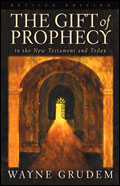


 To Be Continued...